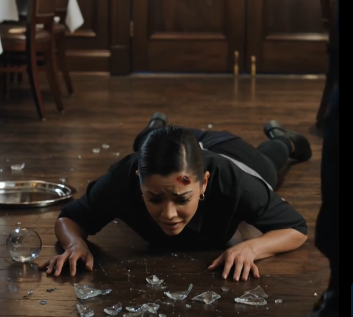
The bald man opened his mouth, closed it again, and looked suddenly less like a predator and more like a man who had just watched his own grave open.
The stranger never raised his voice.
That made it worse.
“What child?” he repeated.
I pushed myself up on one elbow, ignoring the glass cutting into my palm.
All my life, I had believed the story my aunt told me: my mother died in a car fire after running from dangerous people, and I survived only because she had sent me away hours earlier.
But now the bald man had said it himself.
We buried the child with her.
Not a child.
The child.
Me.
The stranger looked back at me, and for the first time his expression cracked.
“My name is Luca Marro,” he said.
My heart stopped.
Marro.
Same last name.
Same eyes as my mother in the one photograph I kept hidden in my shoe box.
Same scar through the eyebrow as the man in her old letters.
My uncle.
The brother my aunt said vanished before I was born.
The brother she always refused to discuss.
Luca turned to the whole restaurant and asked, “Who gave the order?”
The bald man tried to recover. “Boss, she’s confusing you. She’s just some waitress—”
Luca hit him so hard the man crashed into a table and took half the crystal with him.
Nobody screamed.
Nobody dared.
Then Luca looked down at him and said, “You told me my sister died in that fire. You told me the baby’s body was found.”
The bald man spat blood and finally said the truth because fear had taken everything else from him.
“The body was never hers.”
I felt sick instantly.
Twelve years earlier, Isabel had tried to run after discovering that Luca’s business partner was laundering money through the restaurant chain they used as cover. She fled with her infant daughter — me — and evidence hidden inside that little saint medal.
But before she could get far, they caught her.
Luca had been told she betrayed the family and died with the child in the fire.
A lie.
In reality, Isabel handed the baby to a kitchen worker in the alley seconds before the car was set alight. The worker disappeared with me and raised me under another name.
My mother died making sure I didn’t.
Luca had spent twelve years believing his own sister buried her child beside her.
And the men who lied to him had been standing at his table ever since.
I was still on the floor when Luca knelt again and reached very carefully for the medal at my throat.
“Your mother hid something in this,” he said softly. “Did anyone ever open it?”
I shook my head.
He unscrewed the tiny back with trembling fingers.
Inside was a rolled strip of paper, yellowed with age.
Luca read it once and went completely still.
Then he handed it to me.
In my mother’s handwriting, it said:
Luca, if she lives, never let them serve her in the house they burned me for escaping.
I started crying so hard I couldn’t see.
Because all at once I understood the worst part:
I had not just been working in any restaurant.
I had been serving tables for six months in the very place built by the men who murdered my mother.
Luca stood up, turned to the stunned guests, and said with terrifying calm:
“Dinner is over.”
Then he looked at the men who had lied to him for twelve years.
“And tonight,” he said, “the family finally buries the right people.”