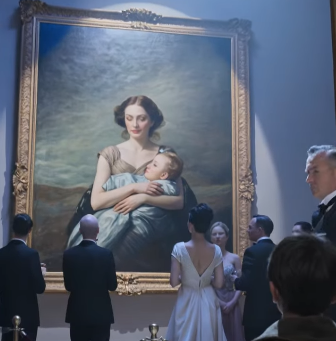
The curator carefully removed the back panel while the crowd watched in stunned silence.
Behind it was a handwritten inscription:
For my son, if they ever let him come back to me.
The patron sponsoring the gala stepped back so suddenly he nearly dropped his glass.
Years ago, his sister — the woman in the portrait — had died after a breakdown following the disappearance of her newborn son. The family insisted the baby had been stillborn. She insisted they had taken him from her.
Everyone called her unstable.
The homeless boy stood motionless, tears in his eyes.
“My mother worked for her,” he said. “She was the seamstress in the house.”
The patron looked sick.
Before dying, the seamstress had confessed the truth: the child had not died. The family had hidden him to avoid scandal, because the mother had conceived him outside of marriage and refused to give him up.
The sketch fragment the boy carried had been torn from the original portrait design and hidden in his blanket.
The patron stared at the child’s face.
Then at the painted woman’s eyes.
They were the same.
“She was telling the truth,” he whispered.
The curator lowered his voice.
“She was.”
The boy took one step closer to the portrait.
“I used to think my mother’s face was just something I made up,” he said.
And in the middle of a room full of people wealthy enough to buy history, one child finally learned that he had been part of it all along.
Would you believe the family… or the child holding the proof?