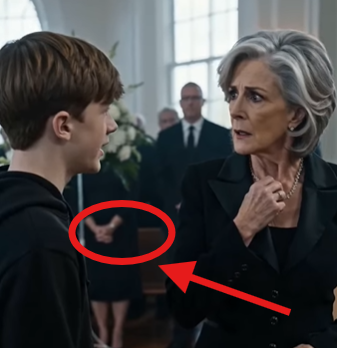
For one long second, no one in the chapel moved.
Not the woman.
Not the mourners.
Not even the boy.
Because now everyone understood that the photograph wasn’t random.
It was evidence.
The older woman stared at the image like it was trying to drag twenty years of silence into the light.
In the photo, the dead man stood younger, softer, with one arm around a woman no one in the chapel recognized.
But around that woman’s neck hung the exact delicate necklace the older woman was wearing now.
Her necklace.
The one she had been told was unique.
A family piece.
A one-of-one gift.
It meant only one thing:
the woman in the photo had once belonged close enough to him to wear what the wife believed belonged only to her.
The teenage boy’s voice shook now, but he kept going.
“He said he took the picture the week before I was born.”
A mourner gasped.
Another stepped closer to the casket as if the dead man might still deny it.
The woman lowered her hand slowly from her mouth. She looked at the boy again — not as an interruption now, not as an insult, but as a possibility she had spent her whole marriage refusing even to imagine.
“Who was she?” she whispered.
The boy swallowed hard.
“My mother.”
That was the sentence that broke the room open.
Because suddenly the hidden visits, the folded photograph, the impossible familiarity in the boy’s face — all of it snapped into one unbearable shape.
He was not just some child the dead man felt sorry for.
He was his son.
The chapel’s grief changed instantly.
It was no longer just mourning.
Now it was exposure.
The boy looked at the casket again.
“He came every year on my birthday,” he said quietly.
“Not always for long. But he came.”
The woman shut her eyes for one second.
That hurt more than the betrayal itself.
Because it meant the dead man had not made one mistake in secret and buried it.
He had maintained a second life with intention. With memory. With ritual.
The mourners behind her were no longer pretending not to understand. They were staring openly now, because the boy had the dead man’s mouth, his eyes, even the same way of holding pain in his jaw.
The woman opened her eyes and looked at the photograph again.
Then at the necklace in the picture.
Then at the one on her own throat.
And in a voice that sounded almost afraid to hear its own truth, she asked:
“Why did he send you to me?”
The boy’s lips trembled.
He pulled one more folded paper from his pocket.
Smaller. More worn.
A note.
“He said if he died before he could tell the truth… you were the only person cruel enough to hate me and honest enough not to abandon me.”
That line silenced even the soft sniffles in the chapel.
Because it sounded exactly like a man who knew both the damage he had caused and the woman he was leaving behind.
The older woman took the note with shaking fingers.
Read it once.
Then again.
And whatever anger had been building in her began to crack under something heavier:
the realization that the dead man had made her responsible for the life he refused to claim in public.
The boy stood there beside the casket, trying not to fall apart.
And suddenly everyone in the chapel understood:
he had not come to ruin the funeral.
He had come because the dead man made sure the truth would arrive exactly when no one could bury it with him.