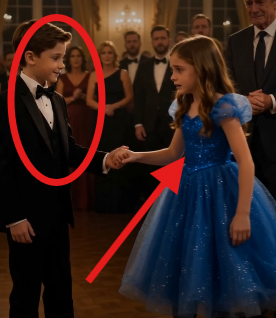
The ballroom was silent.
The little girl stood in the center of the polished floor, trembling on her prosthetic legs, staring at the boy as if he had just pulled her out of another life.
The older man took one shaky step forward, unable to breathe through what he was seeing.
The boy looked at her with wet eyes and a small, proud smile.
Not proud of himself.
Proud of her.
“You just forgot,” he said softly.
The girl blinked at him, confused.
The older man’s face tightened.
Forgot?
What could she possibly have forgotten?
The guests looked from the boy to the girl, trying to understand why this felt bigger than a dance.
The girl’s breathing shook harder now.
The boy stepped a little closer.
“When we were in the hospital garden,” he said, voice trembling, “you told me that when your new legs came, I had to be your first dance.”
The older man froze.
The girl stared at him.
And then it hit her.
A memory.
A bench in a rehab garden.
A weaker, smaller boy in a hospital gown.
Her own voice promising something innocent and impossible.
Tears spilled down her cheeks.
“You were that boy?” she whispered.
He nodded.
The older man covered his mouth.
Years ago, when his daughter was learning how to survive pain, fear, and the cruel weight of being different, she had befriended another sick child at the hospital—a boy who later disappeared after his treatment ended. She had spoken about him for months.
She had never seen him again.
Until tonight.
“I heard you were here,” the boy said. “And I heard you still wouldn’t dance.”
A soft laugh broke through the girl’s tears.
Then a sob followed it.
The older man stepped closer now, utterly overwhelmed.
“You came back for her?” he asked, voice cracking.
The boy looked at him and answered with the simplest truth in the room.
“I came back because she kept me brave first.”
That line shattered what was left of the older man’s control.
He looked at the empty wheelchair.
At the boy.
At the girl standing in the middle of the floor, glowing in blue beneath the chandeliers.
Then the little girl reached for the boy’s hand again.
This time not because she needed help standing—
but because she wanted the promise finished.
“Then dance with me,” she said.
The boy smiled through tears.
He took her hand.
And in the middle of the grand ballroom, under the gold light and in front of a room full of stunned strangers, the two children turned slowly together.
Not perfectly.
Not flawlessly.
But beautifully.
The crowd burst into louder applause than before.
The older man was openly crying now, shaking with emotion as he watched her do the thing he thought fate had stolen forever.
The girl looked up at the boy, laughing through tears.
“You kept your promise.”
And the boy, voice breaking, answered:
“No.
You kept yours.”
The chandeliers glittered above them.
The wheelchair stayed empty behind them.
And for the first time, the whole room understood that this was never just a dance—
it was a miracle they had both carried back to each other.