My name is Lucía Rojas. I’m thirty-one years old, and I live in a small apartment in Valencia with my daughter Alma, who is four. For a long time, I told myself that Javier’s behavior came in “phases”: stress, work problems, silly arguments that got out of hand. I whispered it so I wouldn’t scare Alma—and so I wouldn’t have to admit the obvious: at home, I walked as if the floor were covered in glass.
That afternoon, it all started with something small: spilled milk on the table. Alma froze, eyes wide. I went for a cloth, trying to end the scene before it began. Javier walked in from the hallway with his phone in his hand, looked at the white puddle, and let out a bitter laugh. “You’re useless, even for this,” he said. My cheeks burned, but I answered calmly, like always: “I’ll clean it.”
He didn’t like my tone. He shoved me against the counter, and the impact stole my breath. Alma whispered, “Mama.” I managed to look at her and, without Javier noticing, made the gesture we had practiced as a game for weeks: two taps on my wrist, as if I were wearing an invisible watch. It was our code for “go get the phone.”
Because I already knew that one day something serious would happen. And that’s why, hidden behind the books on the shelf, there was an old phone with no password and one number memorized—a number Alma called “Grandpa’s secret.”
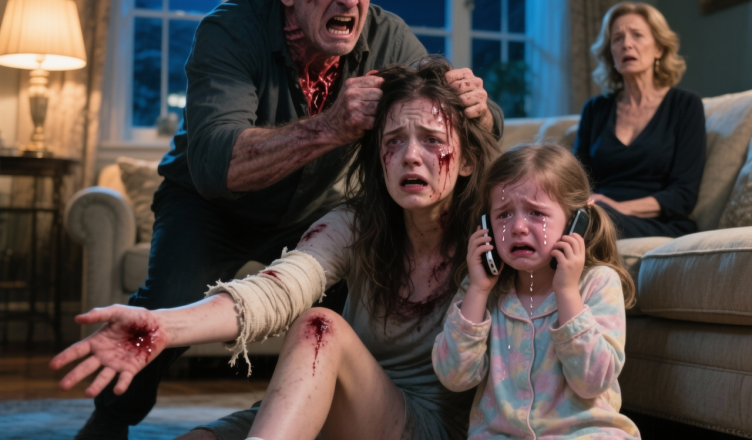
Javier grabbed my arm and pulled me toward the living room. When I tried to break free, he yanked my hair in anger. I felt the pull at my scalp and the fear rising in my throat. He spun me around; I lost my balance and fell badly. A sharp pain shot through my leg, as if something had snapped inside. I couldn’t get up. The world turned into a buzzing blur.
Alma disappeared without making a sound. I saw her socks cross the hallway, heard a drawer open, and then—while Javier kept shouting over me—I heard the ringtone and my daughter’s trembling but clear voice: “Grandpa… Mommy looks like she’s going to die.”
I don’t know how much time passed between that sentence and the sound of the doorbell, but I remember every second as if carved in stone. Javier froze for a moment, as if the air had changed density. He looked toward the hallway and then at me with that expression that always chilled me—the look of someone calculating consequences.
I tried to sit up. I couldn’t. My leg gave out; the pain was deep and relentless, and my vision blurred. But my greatest fear wasn’t the bone—it was Alma. I imagined her holding the phone, small and alone, trying to explain a situation no adult should have to face.
The doorbell rang again, followed by heavy knocking. Javier muttered a curse and walked toward the door. I dragged myself closer to the sofa to lean against it. I tried to shout, but my voice barely came out. Then I heard my father Manuel’s voice from the hallway—firm, sharp, like when he taught me to ride a bike. “Lucía! Open up! I’ve called emergency services!”
Javier opened the door a crack and said something quickly, a clumsy lie: that it was all a misunderstanding, that I was hysterical. My father didn’t move. “I can see my granddaughter crying. Open the door. Now.” Alma appeared behind him, clinging to his leg, her face soaked with tears. My heart broke when I saw her—but I also felt a wave of relief. She wasn’t alone.
Javier tried to close the door, but at that moment two police officers and a paramedic arrived. Everything became concrete: clear questions, swift hands, a professional tone that didn’t allow excuses. One officer knelt beside me and told me to breathe slowly. The other spoke to Javier separately, calm but firm. My father picked Alma up, pressed her head to his shoulder, and whispered that she had done perfectly.
In the ambulance, while they placed a splint on my leg, an old guilt surfaced: “Why didn’t I leave sooner?” The paramedic looked at me as if she had read my thoughts. “Surviving isn’t cowardice,” she said. “Today you took the first step.”
At the hospital they confirmed the fracture. They documented the injuries and offered support services. I signed papers with a trembling hand, but for the first time in years, I wasn’t trembling because of Javier’s control—I was trembling because he was losing it. When I was allowed to see Alma, she touched my cheek softly and asked, “Are we safe now, Mommy?”
I answered with the hardest and newest truth: “We’re starting to be.”
The days that followed were a strange mix of physical pain and mental clarity. I moved into my parents’ home, into a room that used to be storage and that my mother turned into a refuge with clean sheets and a warm lamp. My leg would heal. The harder wound was unlearning the habit of apologizing for existing.
Alma woke up some nights. She didn’t scream; she let out a small whimper and looked for my hand. I learned to breathe with her, to name things to ground us: “We’re here. There’s light. Grandpa is nearby. No one is coming in.” In child therapy they explained that we didn’t need to force questions—just build safety, day after day, like laying bricks in a wall.
I started seeing a psychologist too. She said something that left me breathless: “Violence doesn’t begin with a punch; it begins when someone convinces you that you don’t deserve another life.” That’s when I understood why I had stayed so long. It wasn’t stupidity. It was erosion. Javier had isolated me with words, silences, shame. He had taken away my mirror. I just had to get it back.
There were reports filed, statements given, protective measures requested. It wasn’t easy. Sometimes I wanted to step back, to think maybe I was “overreacting.” But every time doubt crept in, I remembered Alma holding the phone, using a code I had taught her to survive. If my daughter understood that this wasn’t normal, how could I keep calling it “arguments”?
My father didn’t treat me like a child or like someone to blame. He treated me like someone standing up again. “I didn’t save you,” he told me one day in the kitchen. “You saved yourself when you gave Alma a way out.” And Alma, with her four-year-old logic, added: “I called because you looked at me.” That sentence will stay with me forever.
With time, I walked again. First with crutches, then slowly, then with firmer and firmer steps. And although this story began with fear, I want it to end with something different: an open door.
If you’re reading this in Spain or anywhere else and something in this story feels too familiar, please don’t stay silent. Talk to someone you trust. Seek professional support. Make a safety plan. And if you know someone who might be living something similar, don’t ask, “Why doesn’t she leave?” Instead say, “I’m here. How can I help?”
And now I ask you, respectfully: what detail in this story made you realize that Lucía had been preparing her way out long before that day? If you’d like, share it in the comments and pass this story on to someone who may need it. Sometimes, a signal at the right time changes a life.