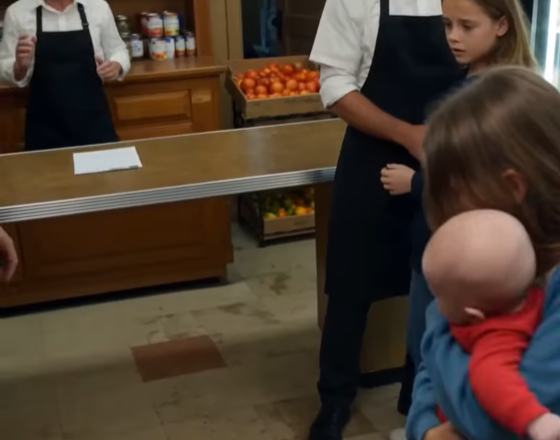
The man in the suit stopped with his hand still on the office door.
The knock came again.
Harder.
The baby started crying.
The girl backed into the milk fridge, shaking her head.
“Please,” she whispered. “He said if I asked for food, she would never come back.”
The clerk’s eyes dropped to the floor.
Too fast.
The man saw it.
“You know him?”
The clerk didn’t answer.
Outside the glass, a man in a delivery jacket pressed his face near the door and shouted, “Open up. She stole from us.”
The girl cried, “No, I didn’t.”
The man in the suit stepped in front of her.
“What did she steal?”
The girl pulled something from inside the baby blanket.
A folded paper.
Not money.
Not food.
A list.
Names of families.
Dates.
Emergency food box numbers.
The man looked at it, then at the locked office shelves.
His face darkened.
The clerk whispered, “Sir, I can explain.”
The girl shook her head through tears.
“My mom made that list. She said the boxes were for hungry people.”
The man outside hit the glass again.
“She talks too much, just like her mother.”
That sentence changed the whole store.
The man in the suit turned slowly toward the clerk.
“You told me the emergency program was running.”
The clerk swallowed.
“It was complicated.”
The girl’s voice broke.
“My mom found the boxes in the office. She tried to give one to a baby.”
She looked down at her brother.
“Mine.”
The baby’s cry had become weak again.
The man picked up one emergency box and opened it.
Formula.
Milk vouchers.
Baby food.
Medicine coupons.
Everything the girl had been begging for was sitting ten feet away behind a locked door.
The man’s hands began to shake.
“My grandmother built this store after she survived hunger,” he said quietly. “She made one rule.”
He looked at the plaque near the door.
“No child leaves hungry.”
The clerk stepped back.
The delivery man outside suddenly tried to walk away.
Too late.
A woman from the bread aisle blocked the door.
Another shopper lifted her phone.
The man in the suit pointed to the security camera.
“Save the footage.”
Then he looked at the clerk.
“All of it.”
The girl whispered, “Where is my mom?”
The clerk said nothing.
The man outside shouted, “She’s fine.”
But his voice cracked.
The man in the suit opened the glass door himself.
The delivery man tried to run.
Two shoppers grabbed him before he reached the sidewalk.
And behind his parked van, wrapped in a torn store apron, a woman slowly lifted her head.
The girl screamed.
“Mom!”
She ran so fast the milk carton fell from her hand.
This time, it burst on the floor.
No one cared.
The man in the suit picked up the baby and followed her outside.
The mother was weak, shaking, but alive.
Her first words were not for herself.
“The baby,” she whispered. “Did he eat?”
The man’s eyes filled.
Not because of guilt alone.
Because a mother who had been locked out, threatened, and hidden behind a van was still thinking only about her hungry child.
He knelt beside her.
“He will.”
Then he looked back at the store, at the clerk, at the full shelves, at the emergency boxes that had waited silently while children cried.
His voice turned cold.
“And so will every child whose name is on your list.”
The girl held her mother’s hand with one hand and the empty bottle with the other.
“Do we have to pay later?”
The man looked at her.
Then at the founder’s plaque.
“No.”
His voice softened.
“You already paid with fear.”
He picked up the first emergency box and placed it in her arms.
“Now it’s our turn to pay attention.”