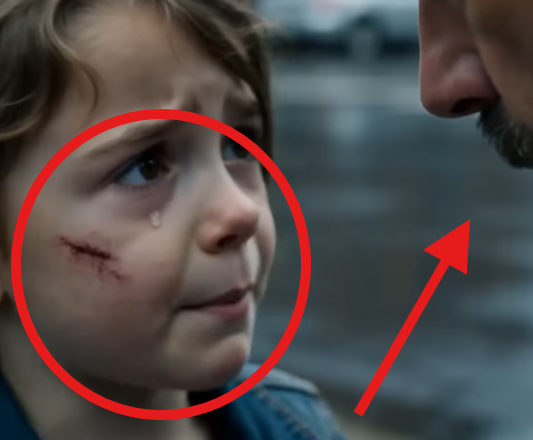
The man in the grey coat looked at the eviction notice again.
Then at the little girl’s bicycle.
Then at the suited man walking toward them with a smile that did not reach his eyes.
“You should move along,” the suited man said.
The girl gripped the bicycle handle.
Her knuckles went white.
The man in the grey coat stayed crouched, keeping his body between her and the suits.
“What is your name?” he asked her softly.
“Mia.”
“And your mom?”
“Lena.”
The name hit him.
Not hard enough for the girl to notice.
Hard enough for his hand to tighten around the eviction paper.
The suited man took another step.
“That document is private.”
The man in the grey coat stood slowly.
“No. Taking food from a hungry family is private. This is evidence.”
The suited man’s smile faded.
Behind him, the other three men stopped pretending not to listen.
Mia whispered, “They said if Mom called anyone, they’d take the bike too.”
The man looked at the cardboard sign.
FOR SALE.
The letters were written by a child trying to save an adult.
That broke something in him.
He pulled out his phone.
The suited man’s voice sharpened.
“Who are you calling?”
The man looked at him.
“The woman who owns the building.”
The suited man laughed once.
“She won’t answer you.”
The call connected.
A woman’s voice came through the speaker.
“Daniel?”
The suited man’s face changed instantly.
Mia looked up.
“You know her?”
Daniel’s eyes stayed on the men.
“She’s my sister.”
The street went silent except for the wet traffic behind them.
Daniel spoke into the phone.
“Did you approve an eviction on unit 4B?”
The woman on the phone sounded confused.
“No. That building is under hardship protection until spring.”
The suited man stepped backward.
Daniel’s voice turned colder.
“And did you send collectors to remove food from a tenant’s home?”
There was a pause.
Then his sister’s voice changed.
“What collectors?”
Mia’s lips trembled.
“They took the bread. And the rice. And Mom’s medicine.”
Daniel’s face hardened.
The woman on the phone heard it.
“All of that is being recorded,” she said. “Keep them there.”
One of the men turned to leave.
Daniel lifted the phone higher.
“Police are already being called.”
The suited man snapped, “You don’t understand. Her mother owes months.”
Mia suddenly reached into the bicycle basket and pulled out a small cloth pouch.
Inside were coins.
Receipts.
And a hospital bracelet.
“Mom paid,” she whispered. “She kept every paper.”
Daniel took the receipts.
The amounts matched.
The dates matched.
The signature at the bottom belonged to the man standing in front of them.
His face went pale.
Mia looked from one adult to the other.
“Can I keep my bike?”
That question destroyed Daniel more than the eviction notice.
Because she didn’t ask for justice.
Or money.
Or revenge.
She asked to keep the last thing they hadn’t taken yet.
Daniel knelt again.
“Yes.”
His voice broke.
“You can keep your bike.”
He took the cardboard sign from the handlebars.
Then he looked at the four men.
“And they can explain why a child thought she had to sell it to feed her mother.”
Across the street, a police car turned the corner.
Mia held the bicycle closer.
The bell rattled softly in her trembling hand.
For the first time that day, the sound didn’t scare her.