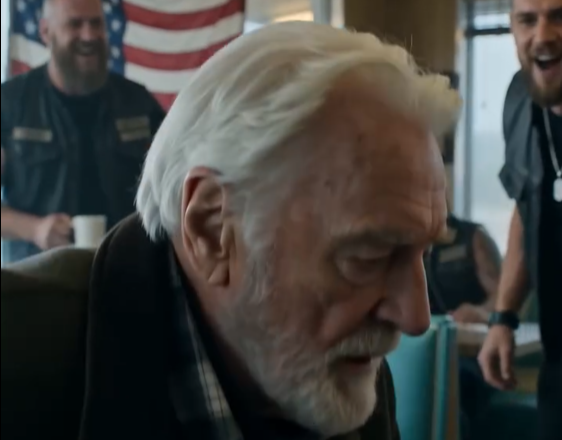
The diner fell silent under the sound of rain.
Three dark vehicles idled outside, their headlights glowing through the wet glass like something old had come back for unfinished business.
The biker tried to laugh.
Nobody joined him.
“Who are they?” he asked.
The old man reached toward the floor for his cane.
His hand trembled.
Not from fear.
From age.
Before he could touch it, the waitress picked it up and placed it gently in his palm.
He nodded once.
“Thank you, ma’am.”
Outside, three elderly men stepped out of the vehicles.
Their faces were blurred by rain and window glare, but their posture was unmistakable.
Straight backs.
Slow steps.
Old wounds hidden under clean coats.
The biker looked confused now.
Then nervous.
The old man stood with effort, leaning on the cane the biker had thrown away.
The old military ring caught the diner light.
The largest of the men outside opened the door.
The bell rang once.
No one moved.
The first man entered with a folded flag pin on his lapel.
The second carried an old leather folder.
The third removed his hat and looked straight at the biker.
The old man said, “I told you boys not to come in unless I called.”
The man with the folder answered, “You called, Colonel.”
That word changed the room.
Colonel.
The biker’s face shifted.
The old man’s eyes stayed calm.
“I’m retired,” he said.
The man with the flag pin looked at the broken glass, the wet table, the cane, and then at the biker’s hand still gripping the old man’s sleeve.
“Doesn’t look retired to me.”
The biker let go.
Too late.
The old man turned toward the waitress.
“Is this the same group?”
Her eyes filled.
She nodded.
“They make people pay to sit in booths. They scare customers away if we don’t give them free meals.”
The biker snapped, “She’s lying.”
The man with the folder opened it.
Inside were printed photos.
Security stills.
Written complaints.
Statements.
The biker stopped talking.
The old man looked at him.
“I came here because she wrote to the veterans’ home.”
The waitress wiped her eyes.
“I didn’t know who else would listen.”
The old man’s voice softened.
“We listened.”
One of the bikers in the back stood up, trying to leave.
The third veteran stepped in front of him.
No threat.
Just presence.
The kind that said some men had spent their youth standing between danger and strangers, and old age had not removed the habit.
The biker who started it all looked at the old man.
“You set me up.”
“No,” the old man said. “You showed up exactly as you are.”
Outside, another set of lights appeared.
Police.
This time the biker truly went pale.
The old man looked down at his cane.
There was a fresh scratch where it had hit the floor.
His thumb brushed over it.
Then he looked at the biker.
“This cane was carved by a boy whose father didn’t come home from war.”
The room became still.
“I carry it because someone loved me enough to make sure I could keep walking.”
His voice hardened.
“You threw it because you thought weakness was funny.”
The biker had no answer.
The waitress whispered, “Colonel… are they going to come back?”
The old man looked at the three veterans beside him.
Then at the police lights outside.
“No.”
He leaned on the cane and took one slow step forward.
“Not to this diner.”
The bell over the door trembled as the police entered.
And for the first time that afternoon, the waitress breathed like the room belonged to decent people again.