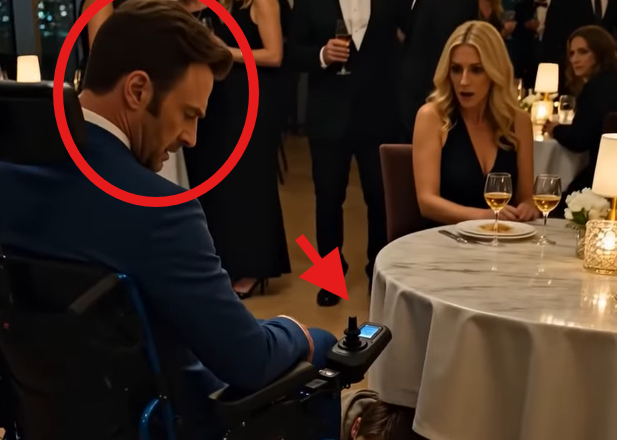
The man did not look at the boy first.
He looked at the doctor.
For years, that man had stood beside his wheelchair with calm hands, clean reports, and the same sentence:
There is no progress.
For years, the man in the blue suit had believed him.
The doctor lifted both hands.
“This child doesn’t understand what he found.”
The boy’s voice shook.
“My mother understood.”
The wheelchair stopped moving.
Even the jazz band went silent.
The man turned slowly.
“Who is your mother?”
The boy swallowed hard.
“Nurse Elena.”
That name hit the man like a memory he had buried alive.
Elena.
The nurse who used to massage his foot when everyone else said it was pointless.
The nurse who told him pain meant the body was still speaking.
The nurse who vanished after writing one report.
The doctor said she resigned.
The boy pulled a folded paper from inside his hoodie.
“My mom didn’t resign.”
He placed it beside the device.
The paper was old.
Soft from being opened too many times.
At the top was the man’s name.
Below it, Elena’s handwriting:
Patient shows nerve response. Independent review recommended. Current treatment may be suppressing recovery.
The man’s breathing broke.
The doctor reached for the paper.
The man slapped his hand down over it.
“No.”
That one word changed the room.
The doctor froze.
The boy pointed at the remote hidden in the doctor’s hand.
“He used that during your pain tests.”
A guest whispered, “Why?”
The boy looked at the man in the wheelchair.
“Because if you got better, the charity money stopped.”
The doctor’s face hardened.
“That’s enough.”
The boy flinched.
Not because he was afraid of being shouted at.
Because he had heard that tone before.
The man noticed.
“What happened to your mother?”
The boy’s eyes filled.
“She kept copies.”
His voice cracked.
“Then she died in a crash the week before she was supposed to testify.”
The doctor stepped backward.
Security entered from the doorway.
The man looked at them.
Then at the doctor.
“Who called security?”
No one answered.
The doctor’s remote slipped slightly in his palm.
The boy reached into his hoodie one last time and pulled out a tiny recorder.
“My mom said if I ever found you, play this.”
He pressed the button.
Elena’s voice filled the silent restaurant.
Soft.
Terrified.
Alive only in sound.
If he is still in that chair, it is not because his body failed. It is because they needed him helpless.
The man covered his mouth.
The boy kept crying, but his hand stayed steady.
The recording continued.
Doctor Harlan changed the readings. The foundation account is tied to his treatment plan. If I disappear, ask who profits from his pain.
Every guest turned toward the doctor.
The woman beside the man in the wheelchair slowly stepped away from him.
Too slowly.
The man saw it.
His voice dropped.
“You knew.”
She began crying instantly.
Beautifully.
Practiced.
“I was protecting you.”
The man looked at his foot.
At the device.
At the boy.
At the report written by a woman who had died trying to give him back his life.
Then he pushed both hands against the arms of his wheelchair.
The boy stepped forward.
“Don’t force it.”
The man looked at him through tears.
“I’m not trying to walk.”
His voice broke.
“I’m trying to stop sitting inside their lie.”
He lifted one foot from the footrest.
It shook.
It hurt.
It barely moved.
But the whole room saw it.
The doctor whispered, “You’ll damage yourself.”
The man looked up.
“No.”
His eyes turned cold.
“You already did.”
Security stopped beside the doctor.
For once, they were not coming for the poor boy.
They were coming for the man with the remote.
The boy picked up the device from the marble table and handed it to security.
Then he looked at the wheelchair.
“My mom said the first truth would hurt.”
The man reached for his hand.
“What did she say after that?”
The boy wiped his face.
“She said pain is not always the enemy.”
He looked at the doctor being led away.
“Sometimes it’s proof they didn’t finish destroying you.”