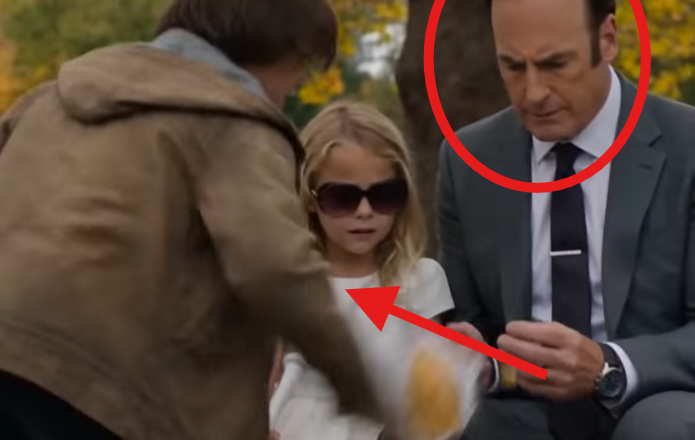
The father dropped to his knees in front of his daughter.
Her sunglasses slipped into the leaves.
Her blue eyes were red and watery, blinking painfully in the pale afternoon light, but they followed his face.
They could see him.
His breath left him in a broken sob.
“Oh, baby…”
The little girl reached for him blindly out of habit, still afraid to trust what her own eyes were showing her.
“I can see shapes,” she whispered. “I always could… but she said the medicine would make me better if I stayed quiet.”
Her father pulled her against his chest, one hand covering the back of her head.
“How long?”
She began crying into his suit.
“Since she heard Grandpa say the house would be mine someday.”
The man closed his eyes.
The truth hit him all at once: the expensive doctors his wife insisted on choosing, the appointments he was never allowed to attend, the way his daughter had begun shaking whenever her stepmother touched her food.
He had called it adjustment.
He had called it grief.
He had never called it fear.
A car door slammed near the path.
The woman hurried toward them, her perfect coat buttoned neatly, her smile already arranged.
“There you are,” she said lightly. “What happened?”
The girl buried her face deeper into her father’s shoulder.
Leo backed away, instinctively ready to run. Children like him learned early that adults with clean clothes were usually believed first.
The woman noticed the bottle in her husband’s hand.
Her smile disappeared.
“Where did you get that?”
The father stood, lifting his daughter into his arms.
“From the boy you never thought anyone would listen to.”
She stared at Leo with sudden fury.
“He’s filthy. He’s lying for money.”
Leo flinched, looking down at his torn shoes.
The little girl lifted her tear-soaked face from her father’s shoulder.
“No, Daddy,” she whispered. “He’s the boy I told you about.”
Her father looked at her.
“What boy?”
“The one who gave me half his bread when she left me alone by the fountain.” She reached one small hand toward Leo. “He was hungry too… but he gave it to me.”
Leo’s chin began to shake.
The father looked at the thin child, his torn jacket, the backpack held together by a knot, and understood that the person who had protected his daughter was the one the whole park would have ignored.
The woman turned sharply toward the parking lot.
The father’s voice stopped her.
“I already called the police.”
For the first time, panic cracked through her polished face.
“You would destroy our family over the word of a street child?”
The father looked down at his daughter’s white cane lying useless in the leaves.
“No,” he said. “You destroyed it when you made my child afraid to open her eyes.”
Sirens rose in the distance.
The woman ran.
She did not get far.
As officers stopped her beside the path, the little girl stretched her hand toward Leo again.
He hesitated.
His stomach growled loudly in the silence, and shame flooded his dirty face.
The father heard it.
He crouched in front of him, still holding his daughter close.
“What’s your name, son?”
“Leo.”
“Leo,” the girl whispered, smiling through tears. “I can see you.”
That was all it took.
The boy who had been brave enough to save her began crying like a child who had never expected anyone to be happy he existed.
Her father held out his free hand.
“Come with us. Let me feed the boy who saved my little girl.”
Leo stared at the warm hand, terrified it might disappear the moment he reached for it.
Then the girl whispered, “Please. I don’t want you to be alone anymore.”
Slowly, Leo placed his dirty fingers in her father’s hand.
And beneath the autumn trees, the little girl walked away without her cane for the first time—one hand holding her father’s, the other holding the hand of the hungry boy who had seen the truth when everyone else only saw rags.