The piano kept singing through the room, and now nobody dared make a sound.
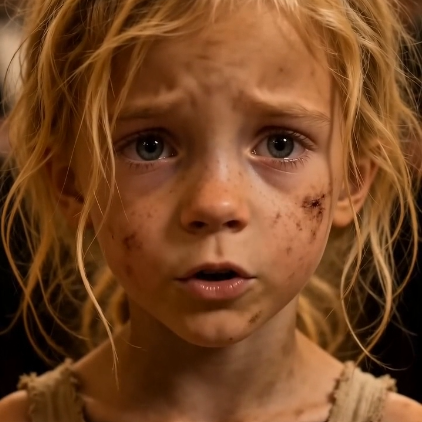
The little girl played with dirty fingers and a straight back, like this was the only place in the world where she was allowed to speak.
When the final note faded, the silence felt heavier than the music.
Then the older woman from the back stepped forward, trembling.
“Who taught you that?” she asked.
The little girl looked up slowly, startled by the softness in her voice.
“My mom,” she said. “She used to play it when I was hungry so I could fall asleep.”
The woman’s mouth opened, but no words came.
“What was your mother’s name?” she whispered.
The girl swallowed.
“Clara.”
The room changed.
The woman covered her mouth as tears rushed into her eyes.
Clara had been her daughter.
The daughter who had walked away from this same world of chandeliers and gold because she fell in love with a poor musician the family refused to accept.
The daughter they had erased with silence.
The little girl reached into the pocket of her torn dress and pulled out a folded photograph.
“She told me if I ever had no food and nowhere to go,” she said softly, “I should come here and play this for my grandmother.”
The woman took the photo with shaking hands.
It was Clara, thinner than she should have been, holding a baby wrapped in a blanket and smiling through tired eyes.
On the back, in faded writing, were the words:
If she finds you, please love her before it’s too late.
The woman dropped to her knees in front of the child, right there on the ballroom floor.
The little girl stared at her, frightened and hopeful all at once.
“Are you my grandma?” she asked.
The woman broke then, tears falling freely in front of the silent room.
“Yes,” she whispered. “And I should have fed you before I ever asked the world to applaud.”