My name is Aarohi Sharma, and I am 24 years old.
Since childhood, I have lived with my stepmother — a cold and practical woman. She repeated the same lesson to me again and again:
“Daughter, never marry a poor man.
You don’t need love; you need a quiet and secure life.”
Back then, I thought it was simply the advice of a woman who had suffered too much in life.
Until the day she forced me to marry a disabled man.
His name is Arnav Malhotra, the only son of one of the richest and most powerful families in Jaipur. Five years ago, he was involved in a car accident that supposedly left him “paralyzed.” Since then, he had lived in privacy and rarely appeared in public.
There were rumors that Arnav was cold, rude, and resentful toward women.
But because of my father’s debts, my stepmother pressured me to accept the marriage.
“If you agree to marry Arnav, the bank won’t take this house.
Please, Aarohi… for your father.”
I bit my lip and nodded.
But inside, I felt humiliation more than anything else.
The wedding was held in a grand ceremony at an ancient palace in Jaipur. I wore a bright red saree embroidered with gold, but my heart felt empty.
The groom sat in a wheelchair, his face cold as marble. He didn’t smile. He didn’t speak. His eyes were fixed on me — deep and mysterious.
Wedding night.
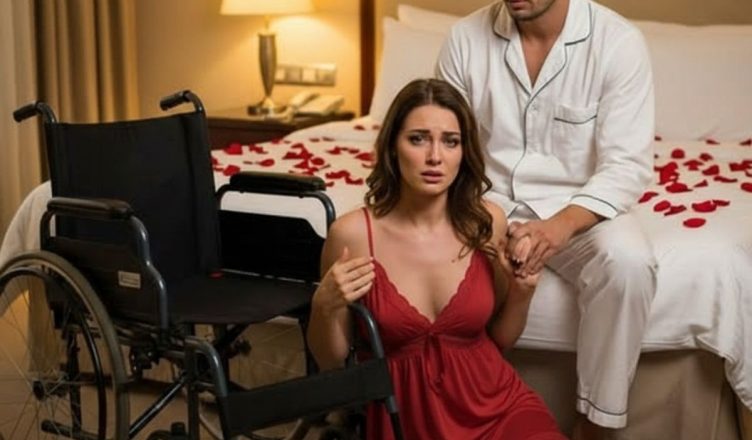
I entered the room nervously. He was still there, seated in his wheelchair, candlelight casting shadows across his handsome but severe face.
“Let me help you lie down,” I said, my voice trembling.
His lips tightened slightly.
“There’s no need. I can manage on my own.”
I stepped back, but I saw his body trembling.
Instinctively, I rushed forward to support him.
“Careful!”
But we fell to the floor together.
The heavy thud echoed through the silent room.
I landed on top of him, my face burning with embarrassment.
And in that exact moment, I was stunned to discover…
…that the weight beneath me moved in a way a paralyzed body never should.
For a fraction of a second, neither of us breathed.
I froze, my palms pressed against his chest, my cheek inches from his collarbone. His body was warm, solid — unmistakably alive in a way that contradicted every story I had been told. Then — very clearly, very deliberately — I felt his thigh tense beneath me.
I pulled away as if burned.
“I—I’m sorry,” I stammered, rising to my knees. “I didn’t mean to… Are you hurt?”
Arnav’s jaw tightened. His eyes — those dark, unreadable eyes — were no longer distant. They were sharp. Alert. Watching me.
“Get up,” he said quietly.
I did, my heart pounding.
He placed one hand on the floor.
And then, slowly — painfully slowly, as if every movement cost him something — he pushed himself upright.
He did not crawl.
He did not collapse.
He rose.
My breath caught.
“You… you moved,” I whispered.
For a long moment, he said nothing. The only sound was the crackling of candles and my own pulse roaring in my ears. Then he let out a humorless laugh.
“So…” he said in a low, controlled voice. “You noticed.”
I stared at him, my mind racing.
“They said you were paralyzed. Everyone said… your family, the doctors, the newspapers…”
“…said what was convenient,” he interrupted.
He moved again — and this time, there was no denying it. His legs moved. Not perfectly. Not easily. But they moved.
I felt dizzy.
“Then why the wheelchair? Why lie?”
His expression darkened.
“Because lies keep people at a distance. And because the truth, in my family, is far more dangerous.”
I sank onto the edge of the bed; my wedding jewelry suddenly felt like chains.
“Then why marry me?”
The question hung between us like a blade.
He looked at me for a long time before answering.
“Because you were the only person they thought wouldn’t matter.”
The words hurt.
“Wouldn’t… matter?”
“My parents,” he said flatly, “needed a wife for me. A woman who would appear obedient. Quiet. Someone whose family could be controlled. Someone who wouldn’t ask questions.”
My stepmother’s voice echoed in my head: You don’t need love. You need security.
A bitter smile tugged at my lips.
“So I was sold. Convenient. Disposable.”
His gaze softened slightly.
“I didn’t know you would be like this.”
“Like what?”
“Someone who steps forward instead of stepping away.”
Silence fell again.
I hugged myself.
“If you’re not paralyzed… how serious is your injury, really?”
He hesitated.
“The accident damaged my spine. I lost movement for almost a year. I fought to regain it — therapy, surgeries, pain you can’t imagine. But I never fully recovered. Some days I can walk. Other days I can’t. Stress makes it worse.”
“And you pretend all the time?”
“Yes.”
“Even with me?”
“I planned to,” he admitted. “At least at first.”
Something inside me cracked — not with anger, but with exhaustion.
“Do you know how humiliating this was? Everyone whispering. Pitying me. Thinking I was being sacrificed.”
“I know,” he said quietly. “That was the point.”
I stood abruptly.
“Then this marriage is a prison for both of us.”
He watched me, expression unreadable.
“It doesn’t have to be.”
I let out a brittle laugh.
“You lied to me on our wedding night. What kind of beginning is that?”
“One that can still change,” he replied.
I turned away, fighting tears.
“I don’t trust you.”
“That’s fair,” he said. “But trust isn’t given, Aarohi. It’s built.”
Hearing my name in his voice startled me. He said it carefully — as if it mattered.
That night, we slept on opposite sides of the bed, a chasm of confusion between us.
The next morning, the palace buzzed with servants and relatives. My stepmother arrived early, eyes sharp as knives.
“Did everything go well?” she asked, lips curved in a polite smile that didn’t reach her eyes.
I looked at Arnav, sitting in his wheelchair, hands folded, playing his role perfectly.
“Yes,” I said calmly. “Everything went exactly as expected.”
Her smile widened.
Days passed. Then weeks.
In public, Arnav was the cold, distant husband. Silent. Motionless. Untouchable. People praised my “sacrifice,” my “patience.” They called me noble. I wanted to scream.
In private, everything was different.
At night, when doors were closed, he stood — sometimes leaning on furniture, sometimes swaying slightly, always stubborn. I helped him without speaking. He never asked, but he never refused.
We talked.
About books. Music. Jaipur at night, when the streets smell of rain and spices. About my mother, who died when I was ten. About the accident — the truck that ran a red light, the months trapped inside his own body, the way his family had already begun planning his “usefulness” before he could walk again.
“They didn’t want a son,” he once said, staring out the window. “They wanted a symbol. A Malhotra who could be displayed and controlled.”
“And you?” I asked.
“I wanted to disappear.”
I looked at him then — not the marble statue from the wedding, but a man marked by pain, pride, and loneliness.
Slowly, something changed between us.
He taught me chess. I taught him to cook simple meals without servants hovering. Sometimes he almost smiled. Sometimes I forgot to be afraid.
But the truth always demands its price.
One afternoon, I overheard my stepmother on the phone.
“She doesn’t know,” she whispered. “Of course not. The marriage contract is signed. Once the Malhotras transfer the second payment, we’re free.”
My blood ran cold.
That night, I confronted Arnav.
“She knew,” I said, voice shaking. “She knew you weren’t fully paralyzed. She helped arrange this.”
His face hardened.
“I suspected.”
“So I wasn’t just convenient,” I whispered. “I was bait.”
He reached for my hand, then hesitated.
“Aarohi…”
“I need to know everything,” I said. “No more lies.”
He took a deep breath.
“The accident wasn’t an accident.”
The world tilted.
“My uncle,” he continued softly. “He wanted control of the company. If I had died, he would have gotten it. When I survived… this was the compromise: a broken heir. Easy to manage.”
“And the marriage?”
“A way to lock me in. A wife from a desperate family would never challenge them. Never question missing money. Never question signatures.”
I felt sick.
“They used me.”
“Yes,” he said. “And I let them.”
The silence that followed was suffocating.
Finally, I asked:
“What do you want?”
He held my gaze.
“My life back. But I can’t do it alone.”
I thought of my father’s debts. My stepmother’s cold smile. A lifetime of being told to endure quietly.
“No,” I said softly. “You won’t be alone.”
From that night on, we became allies.
I helped him secretly document his recovery — videos, medical records, dates. He introduced me to a lawyer he trusted. We traced money, forged signatures, betrayal upon betrayal.
The more I learned, the angrier I became — not just for him, but for myself.
Months later, at a lavish family gathering, Arnav did the unthinkable.
He stood.
A murmur of shock rippled through the hall.
“I have something to say,” he announced, voice steady as he stepped away from the wheelchair. “About the accident. About my recovery. And about the people who thought my wife and I were disposable.”
My stepmother went pale.
I stepped to his side and slipped my hand into his.
In that moment, everything changed.
The truth came out. The evidence was undeniable. His uncle was arrested. Accounts were frozen. The family empire trembled.
And my stepmother?
She disappeared the next day, taking nothing but her pride.
In the quiet aftermath, Arnav turned to me.
“You’re free,” he said. “If you want to leave… I won’t stop you.”
I looked at him — truly looked at the man who had once been a stranger in a wheelchair.
“I wasn’t free before,” I said. “Now I am.”
We rebuilt slowly. With pain. With honesty.
Love didn’t arrive like a storm. It arrived like dawn — soft, inevitable, earned.
On our first anniversary, he walked with me through the palace gardens, no wheelchair in sight.
“I never thanked you,” he said.
“For what?” I asked.
“For seeing me when I was hiding.”
I smiled.
“And you never thanked me for surviving.”
He laughed and pulled me close.
The lesson I learned was simple — and it cost me everything to understand:
Security without truth is just another cage. And love — real love — begins the moment you stop pretending you are broken just to survive.
Sometimes, the most shocking truth isn’t that someone lied to you.
It’s that you were stronger than anyone who tried to use you ever imagined.