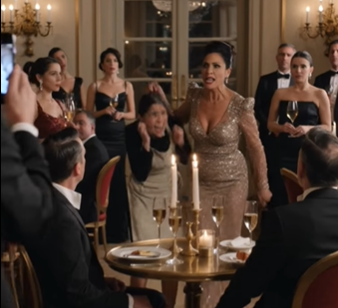
The chandeliers still shimmered overhead, and candlelight still glowed against crystal and polished marble, but the entire room had changed. Just moments earlier, the wealthy woman’s accusation had seemed powerful enough to shape reality by itself. She had been loud, certain, expensive, and furious — all the qualities people in elegant rooms too often mistake for truth. The waitress, by contrast, had been young, poor, frightened, and in uniform. That combination had made her easy to seize, easy to shame, and easy to imagine guilty. But now the necklace was no longer missing, and the story everyone had been ready to believe was beginning to collapse under the weight of the man holding proof in his hand.
The waitress stood with one hand against the edge of the table, trying to steady her breathing. Her scalp still burned where she had been dragged forward. Her apron pocket hung open, exposing the small ordinary contents of a working life to a room full of strangers in tuxedos and couture. Tears still ran down her face, but confusion was overtaking panic now. If the necklace had been hidden in the accuser’s husband’s jacket, then none of this had been about theft. It had been about speed, deflection, and choosing the weakest person in sight before the real scandal could reach the dining room.
The billionaire did not raise his voice. He did not need to. He explained that the necklace had been found minutes earlier near the entrance cloak station after security was quietly asked to locate the missing piece before guests began leaving. The search led not to staff lockers, not to the waitress’s service station, and not to any service corridor. It led to the tailored black dinner jacket belonging to the rich woman’s husband — a man who, according to staff, had stepped away from the table twice during the meal and returned visibly shaken both times. Hidden in the inner lining pocket of that jacket was the necklace, wrapped inside the small velvet pouch the billionaire now held between two fingers.
A murmur spread instantly through the room.
The wealthy woman looked as if she had forgotten how to stand.
“That’s impossible,” she whispered.
The billionaire’s gaze stayed fixed on her.
“It would have been,” he said, “if the pouch had held only the necklace.”
He lifted it slightly.
“Instead, it held something else.”
That line changed the tension in the room from embarrassment to dread.
The guests who had raised their phones now watched with a different kind of hunger. This was no longer a simple luxury scandal. It was becoming the kind of revelation that strips glamour from a table and leaves only panic behind. The waitress, who had just been reduced to tears and humiliation in the middle of the dining room, looked from the billionaire to the woman in front of her and slowly began to understand what the room had not yet fully grasped: she had never been accused because she looked guilty. She had been accused because someone richer needed her to be available.
The billionaire opened the velvet pouch and removed a folded note card.
He said he had not intended to read it aloud. But after walking into his friend’s restaurant and seeing a crying employee dragged by the hair in front of guests while strangers recorded, he had changed his mind. He unfolded the card and read the single line written inside:
If she checks his jacket, everything is over.
The room went still in a new way then.
Not shocked.
Not confused.
Certain.
The wealthy woman’s husband, seated two tables away, had gone so pale that even the candlelight made him look gray. Everyone turned toward him now, and in that turn the whole real scandal came into view. The missing necklace had not been taken by a waitress. It had been hidden by a husband trying to conceal something from his wife. And the wife, having sensed enough danger to panic but not enough truth to control it, had done what frightened powerful people so often do: she chose the nearest powerless woman and tried to destroy her before the room could discover where the shame really belonged.
The billionaire continued with brutal calm. Earlier that evening, the husband had been seen in an alcove near the private corridor speaking intimately with another guest — not his wife, but a younger woman from their table group. Security footage later showed the husband taking the necklace from the table during the confusion of dessert service, slipping it into the velvet pouch, and hiding it inside his own jacket before returning to the dining room. Why? Because the necklace was not merely expensive. It was an anniversary piece, one the wife recognized instantly and guarded possessively. If it vanished, she would explode. And in that explosion, perhaps, other questions might be drowned out.
But the husband had misjudged one thing.
His wife’s cruelty moved faster than his plan.
By the time suspicion reached the table, she was already hunting for someone weaker than herself. The waitress had happened to be nearby, carrying a tray, young enough to frighten, poor enough to discredit, and ordinary enough that half the room would accept her guilt before asking for evidence. That was the true obscenity of the moment. Not merely that the accusation was false — but that it landed so naturally on the girl because everyone in the room had already been trained by class to find it plausible.
The waitress lowered her eyes briefly and saw the tiny saint medal lying among the spilled contents of her pocket. A cheap little thing. Something probably gifted by her mother or grandmother. It looked heartbreakingly small against the marble floor and the glittering cruelty of the dining room. Her private life had been ripped open under chandeliers because someone wealthier needed a shield. And now that understanding was settling into her posture, replacing raw panic with something quieter and harder to ignore.
The billionaire then said there was more. The husband’s jacket pocket had also contained a hotel key card sleeve from a suite upstairs — one booked not in his own name, but under the name of the younger woman he had been meeting. The note in the pouch, therefore, was not about the necklace alone. It was about exposure. If his wife checked his jacket, she would not only find the necklace. She would find the beginning of a much larger betrayal. The theft accusation downstairs had not been about recovering diamonds. It had been about a marriage collapsing in real time and a desperate, violent need to make someone else collapse first.
The wealthy woman’s face had changed completely now. Her rage was still there, but it was no longer victorious. It looked wounded, cornered, humiliated — and worst of all, seen. Yet nothing in that pain could undo what she had done. Betrayal may have cracked her composure, but cruelty had guided her hands. She had dragged a girl by the hair, emptied her pocket, and called her filth before a room full of strangers. The husband’s deceit explained her panic. It did not excuse her choice.
One by one, guests began lowering their phones.
Not because the scene had become less dramatic.
Because it had become harder to watch without seeing themselves in the silence that allowed it to begin.
The billionaire stepped closer to the waitress then and, without touching her, positioned himself unmistakably between her and the woman who had just humiliated her. It was a small gesture, but in that room it felt enormous. For the first time that evening, someone powerful had made it clear which side of the scandal deserved protection.
The waitress was still shaking.
Still crying.
Still humiliated.
Still trying to breathe through the shock.
But she was no longer shrinking.
When she finally looked at the woman who had dragged her forward and called her a thief under chandelier light, her voice came out soft — so soft the whole restaurant had to lean into it.
“You never wanted your necklace back,” she said.
Her eyes moved once toward the husband, then back to the wife.
“You just needed someone smaller than your marriage to punish first.”