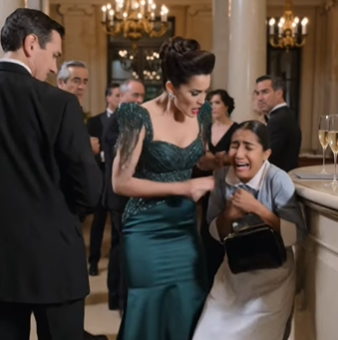
The chandeliers still burned above the polished columns. Soft music still hovered unfinished in the air. Guests held their phones and champagne glasses in total silence, no longer hungry for scandal, no longer sure they were watching one. Only moments earlier, the scene had seemed brutally simple: a rich woman raging, a poor maid crying, a missing diamond brooch, a public accusation sharp enough to turn humiliation into entertainment. But the old photograph had changed everything. The brooch no longer felt important. The spilled service bag no longer looked like the wreckage of a servant’s embarrassment. It looked like the accidental opening of a grave someone had paid to keep sealed.
The maid slowly pulled herself upright, one hand still braced against the reception desk because her knees no longer trusted her. Tears streaked her face, and the mark where she had been shoved was beginning to rise on her arm. But the fear in her expression had shifted. Before, she had been terrified of being falsely blamed in front of strangers. Now she looked like someone standing at the edge of a truth she had been warned about all her life without ever being allowed to understand it.
The older guest held the photograph very carefully, almost reverently, as though roughness itself would be dangerous. He explained that he had attended the private engagement dinner in the hotel more than twenty years earlier, when the owner — then not yet the empire-building name he would become — was meant to announce his marriage to a woman Paris society never entirely accepted. She was elegant, discreet, and quieter than the circles around her. Too quiet, some said. Too beautiful to ignore, others said. What nobody publicly admitted was that she had arrived that night carrying an infant girl, hidden from most of the guests and kept upstairs in room 417 with a nurse until the dinner ended. The child was never meant to be seen. The official story later claimed the bride vanished alone before midnight. But the photograph in his hand proved something else. She had not been alone. There had been a baby in her arms.
A murmur moved through the lobby.
The socialite in emerald looked as if she had stopped breathing properly.
The maid swallowed and asked, very softly, “You knew my mother?”
The older guest looked at her with something close to grief.
“No,” he said. “But I knew the woman holding you.”
That landed over the room like a sentence.
He said the photograph had been taken in the private sitting room adjacent to 417, just before dinner service. He remembered because the bride had objected to being photographed, then reluctantly agreed only after the owner insisted it was “for the family archive.” Later that same night, guests were told she had become emotional, left the suite, and disappeared before the formal announcement could happen. Staff were instructed not to speak. The suite was quietly resealed the following week. And whenever anyone asked what became of the child rumored to have been with her, the answer was always the same: there had been no child.
Now the room knew that was a lie.
The maid’s breathing turned ragged again. She said her mother had worked as a cleaner and seamstress for most of her life, moving often, avoiding wealthy districts, panicking whenever anyone mentioned old Paris hotel families. She never spoke clearly about the past. But on the night she died, she gave her daughter that photograph and said only one thing with absolute force: If anyone in that hotel ever humiliates you publicly, don’t defend yourself first. Ask them what happened in room 417. As a child, the maid had thought it sounded like a fever dream, a bitter fragment from a woman too ill to explain herself. Standing there on the marble, with the photograph exposed and the lobby staring, she finally understood that it had been an instruction.
The older guest asked her mother’s name.
When she answered, his face went completely still.
The name was not the vanished bride’s.
It was the nurse.
The woman hired privately to remain with the child upstairs while the family dinner took place below.
That revelation altered the shape of the silence all over again.
Because now the maid was not simply linked to the bride through sentiment or rumor. She was the child who should have disappeared from the story entirely. The nurse had not died. She had fled. Or been sent away. Or escaped. But however it happened, she had taken the infant with her and hidden her life under labor, poverty, and silence. The photograph had survived because some truths refuse to die even when every powerful person around them agrees they should.
The socialite tried to recover control.
“This is absurd,” she said too quickly. “This girl is a maid. She’s repeating nonsense from a sick woman.”
But the room no longer belonged to her voice.
The older guest turned toward her and asked a devastating question: if there was never a child, why had the owner’s legal team demanded the original family-archive photographs from that night be destroyed? He had not understood the urgency then. Now, looking at the girl in front of him, he did. A vanished bride is a scandal. A vanished bride with an infant daughter is inheritance.
That word settled into the lobby with lethal weight.
Inheritance.
Not romance.
Not gossip.
Not an old affair.
Blood.
The maid looked around at the guests who had watched her being shoved and searched as if she were nothing. Moments ago she had been the easiest person in the room to accuse: young, poor, in uniform, carrying a service bag instead of a surname. Now the same room had to look at her differently. Not because she had suddenly become rich or powerful, but because the truth had made her dangerous to the people who benefited from her erasure.
The older guest said there was more. Room 417 had not simply been sealed because of grief. It was sealed because the owner himself ordered the suite closed until “all personal matters are resolved,” wording so strange that staff repeated it for years afterward. No guest stayed there again. Furniture was removed. Locks were changed. Inventory from the sitting room was quietly transferred to private storage. And yet one object was never accounted for in the internal records: a blue velvet brooch case listed as belonging to the bride. The same family line, he said, that the socialite’s missing brooch came from tonight.
At that, every eye turned to the woman in emerald.
Her expression gave her away before any denial could.
Because now the accusation downstairs no longer looked spontaneous. It looked triggered. Something about the maid — the face, perhaps the staff-file surname, perhaps sheer resemblance under the wrong light — had struck fear before the brooch ever became an excuse. The public humiliation had moved too fast, too hard, too personally. This was not how a woman behaves when she suspects a servant of petty theft. It was how she behaves when the wrong ghost walks back into the house.
The maid bent slowly and picked up the items spilled from her bag. A cloth. A cheap compact. A worn photograph from another life. Such ordinary things. Yet lying on polished marble beneath chandelier light, they had become proof of how easily the powerful turn poverty into camouflage for their own panic. She was still crying, still shaking, still humiliated before strangers who had done nothing to stop it. But something steadier had entered her posture now. Dignity, yes. But also lineage. Memory. The right to ask questions that money had postponed for decades.
The older guest lowered his voice further and said the final detail everyone deserved to hear. The bride had once told him, just hours before she disappeared, that if anything happened to her, “the woman in 417 will know which name belongs to the child.” At the time, he thought she meant the nurse would choose a safer identity. Now he understood she meant the child’s true name would have to be hidden until accusation forced it into the light. Until the family, through cruelty, revealed what it feared.
One by one, the phones lowered.
Not because the drama had ended.
Because everyone now understood they were not watching a maid accused of theft.
They were watching a buried daughter pushed back into the story by violence.
The maid looked at the socialite who had shoved her, torn open her bag, and called her a liar in front of half of Paris’s elite.
When she spoke, her voice was soft enough to force the whole lobby into listening.
“You didn’t think I stole your brooch,” she said.
Her fingers closed around the tiny photograph.
“You were afraid someone would finally ask why a bride disappeared from room 417 with a child your world claimed never existed.”