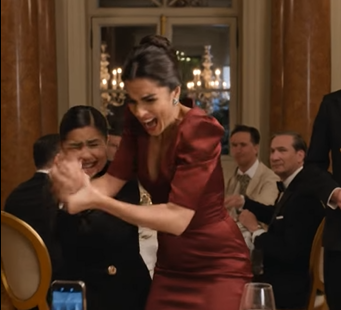
The candles still flickered across white linen and champagne glasses. The violinist stood frozen near the far wall, bow lowered, while the guests who had lifted their phones no longer looked entertained by scandal. The room had changed too completely for that. Only moments earlier, the story had seemed simple enough for everyone to accept without resistance: a rich woman’s missing diamond ring, a poor hostess in tears, a public accusation, a forced hand opened under chandelier light. But now the ring no longer mattered. The tiny photograph in the older man’s hand had cracked the evening open in a far more dangerous place.
The hostess stood in the center of the room, shaking so badly she could barely stay upright. Her fingers were still curled from where they had been forced apart. Her face was wet with humiliation, but something else had entered it now — a deeper terror, the terror of someone realizing the warning she carried from childhood was not madness, not grief, not some broken story from a dying mother. It had been precise. Her mother had known that if this family ever turned on her daughter publicly, the past would not stay buried much longer.
The older man stared at the photograph as though time itself had betrayed him.
He explained, with visible difficulty, that the image was unmistakable. It had been taken in a private room upstairs on the night his younger brother was supposed to celebrate his engagement to a woman the family never fully accepted. She was beautiful, quiet, and came from a background the richer relatives liked to describe as “uncertain” whenever they wanted to insult her politely. There had been dinner, flowers, music, and a photographer brought in only for family keepsakes. Then, sometime before midnight, the bride-to-be vanished. By morning, the story told to everyone outside the family was simple: she panicked, fled, and abandoned the engagement. No police scandal. No public disgrace. No questions. The family closed ranks, money did what money always does, and the truth disappeared with her.
But the older man had never seen that particular photograph after that night.
In the image, his brother’s fiancée was holding a baby girl in her arms — a child no one had ever admitted was with her that evening.
The hostess’s breathing turned ragged.
“My mother kept that picture hidden in a lining seam,” she said softly. “She only showed it to me once.”
The rich woman in red looked as though she had forgotten how to breathe.
The older man asked her mother’s name.
When the hostess answered, the room changed again.
Because it was the vanished bride’s name.
Not similar.
Not close.
The same.
A murmur spread from table to table.
The hostess wiped at her face with trembling fingers and said her mother had raised her alone, moving from city to city, never staying too long, never trusting wealthy people, never entering places like that unless work left no choice. She never explained who her father was. She never explained why she trembled whenever Rome society names appeared in magazines. But every year, on the same date, she would take out the photograph, stare at it for a long time, and say: If they ever humiliate you in public, it means they’re more afraid than angry. Ask them what happened that night.
At the time, the hostess had thought it was grief talking.
Now, in the middle of a room full of chandeliers and silence, it sounded like instruction.
The older man slowly raised his eyes from the photograph to the woman in red.
She was no longer angry in any convincing way. She was exposed.
Because now everyone in the restaurant could see what she herself had understood the moment that photograph fell from the hostess’s sleeve: this was never a simple theft accusation. The hostess had not been chosen because she looked guilty. She had been chosen because she stood too close to a history someone at that table recognized before the room did.
The older man asked one devastating question.
“If this girl is the child from that photograph… then who told us there was no child?”
No one answered.
The silence itself became confession.
The woman in red tried at last to recover. She said the girl’s mother had been unstable, manipulative, capable of inventing anything. She insisted the photograph proved nothing, that desperate women keep sentimental lies. But her voice no longer held authority. She had already spent that authority on cruelty. After dragging a girl into the center of a dining room and prying open her hand while strangers filmed, every word she spoke now sounded like self-defense, not truth.
The older man’s face hardened.
He said he remembered one more thing from that night — something he had dismissed at the time because his brother begged him to. The bride had tried to leave early. There had been an argument behind closed doors. His brother’s future wife — the very woman now standing in dark red couture in the middle of the room — had entered that argument uninvited. At the time she was merely “a family friend,” someone always near the family, always elegant, always helpful. After the vanished bride disappeared, that same woman became the next fiancée within the year.
A sound escaped the room.
Because now the shape of the scandal was unmistakable.
The poor hostess on the floor was not just some employee accused of theft. She might be the living evidence of a family replacement — a woman removed, a child hidden, and another woman stepping neatly into the life that should never have been hers.
The hostess felt the room change around her.
Moments earlier, she had been the weakest person there. The easiest to blame. The easiest to shame. The easiest to force open beneath gold light and old money. But now the same room was looking at her differently — not with simple pity, but with that more dangerous kind of attention that comes when someone poor is suddenly standing at the edge of an inheritance of truth.
She looked at the older man and asked, almost like a child again:
“Did my mother run away?”
His answer came quietly.
“No.”
That single word shattered whatever remained of the lie.
He said his brother had insisted for years that the vanished bride left voluntarily. But he remembered the torn hem on her dress. He remembered the baby blanket left behind upstairs. He remembered a bracelet clasp broken near the private stairwell. And now, seeing the child from that hidden photograph standing alive in the middle of his family’s dining room, he understood what he had refused to understand for two decades: she had not vanished from the family story because she abandoned it. She vanished because someone made her disappear from it.
Every eye turned to the woman in red.
She looked as if the entire room had become too small to breathe in.
The hostess lowered her gaze briefly to her own hands — the same hands that had just been forced open for strangers as though poverty itself were evidence. She was still crying. Still shaking. Still humiliated. But now dignity had returned in a different form: not strength exactly, not yet, but bloodline, memory, and the right to ask questions the room had trained itself never to ask.
The older man handed her the photograph with extraordinary care, as if returning far more than paper.
Then he said there was one final detail everyone deserved to hear.
His brother had once written a private note after that night — not to the police, not to the newspapers, but to him. He had burned most of it years later out of loyalty and cowardice. But one line had stayed in his memory because it made no sense then and makes terrible sense now:
If the child ever returns, do not let her be accused the way we accused her mother.
The restaurant seemed to stop breathing.
The woman in red closed her eyes.
Too late.
The hostess lifted her face and looked directly at the woman who had dragged her into the center of the dining room and tried to break her before strangers.
When she spoke, her voice was soft — but in that silence, it reached every table.
“You didn’t think I stole your ring,” she said.
She held the old photograph against her chest.
“You recognized my mother’s night in my face before I ever knew it was mine.”