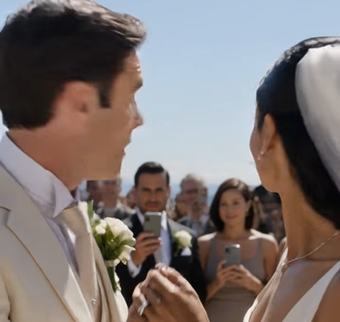
The flowers still trembled in the warm breeze. Sunlight still lay across the white chairs and scattered rose petals. The champagne tower glittered untouched near the reception terrace, and half the guests stood frozen with their phones in hand, no longer filming a romantic ceremony interrupted by chaos, but something much uglier — a secret that had just stepped into daylight wearing a child’s face.
The bride remained standing in front of the groom, but she no longer looked like a woman at the center of her wedding. She looked like someone who had just realized the entire day had been built on a lie strong enough to survive until the exact moment the ring was raised. Her expression had changed from shock to something more dangerous: calculation. She was remembering every delay, every unexplained absence, every answer that came too quickly or too late. And now those memories had shape.
The poor woman held the little boy close, trying to calm his breathing even as her own body shook. She looked as though she had spent months, maybe years, trying to stay far away from this moment — and then finally understood there was no safe way to keep the truth hidden once the child himself became old enough to ask why he had his father’s eyes and someone else’s name. Her dress was simple, her shoes dusty from the road leading up to the garden, and the elegance of the wedding only made her exhaustion more visible. But what had once made her easy to dismiss in a place like that now made the whole scene more brutal. She did not look like an intruder crashing a fantasy. She looked like the consequence of one.
The older relative stepped closer, still staring at the child. He explained, in a voice strained by memory, that years earlier the groom had once been engaged before — a quieter engagement, never publicly announced to the full family because, as he put it, “there were complications.” The fiancée vanished abruptly. The official explanation had been that she left the country after a nervous collapse and wanted no contact with anyone. Some relatives believed it. Others did not. The timing was always wrong. The disappearance was too clean. The silence afterward was too carefully maintained. Now, looking at the child and hearing his age spoken aloud in his own mind, he knew the dates fit too perfectly to ignore.
The bride turned slowly toward the groom.
“You were engaged before me?” she asked.
He opened his mouth, but no words came out.
That silence finished the answer for him.
A murmur spread across the guests.
The poor woman finally spoke again, her voice unsteady but no longer weak. She said she met him after that disappearance — not at a party, not in some glamorous affair, but at one of the apartments he kept “for privacy.” He told her the previous engagement was over, that the woman had left him broken and embarrassed, that he was trying to start again quietly. He was tender when it suited him, frightened when she asked too many questions, and always very careful to keep her away from anyone who might connect names, dates, and faces. By the time she realized she was pregnant, he had already begun vanishing for days at a time. Then came the promises: money, support, a separate flat, time to “sort things out,” and above all, one condition — no public scenes, no family contact, no mention of the child until he found the “right moment.”
The bride shut her eyes for one second.
Only one.
When she opened them again, the wedding no longer belonged to him.
The poor woman said there was never a right moment. Only delays. Delays until the child could walk. Delays until he could speak. Delays until he could ask why the man in the photos hugged him in private but did not exist in public. She said she would have stayed away longer if it had only been about her humiliation. But children do not stay quiet inside adult lies. This morning, when the boy saw his father’s face printed on the welcome sign beside the wedding entrance, he stopped and asked, “Why is my dad marrying someone else?” And when she tried to leave with him before the ceremony began, he broke free and ran.
That truth hit the guests harder than scandal usually does.
Because now the interruption no longer looked staged.
It looked inevitable.
The bride’s gaze dropped to the child. He had gone quiet now, clutching his mother’s arm and looking confused by the size of the silence around him. He was too young to understand social collapse, but old enough to know the man at the altar mattered to him. The resemblance was unbearable now that no one could pretend not to see it. The same brows. The same chin. The same startled look under pressure. It was as if the groom had been made smaller, stripped of wealth and polish, and placed in the aisle to expose him.
The older relative then revealed the detail that cracked the ceremony open completely. The vanished fiancée had not simply disappeared. She had confronted the family shortly before leaving, saying she believed the groom was hiding “a second life” and that if anything happened to her reputation, she wanted the dates remembered. At the time, they dismissed it as heartbreak speaking wildly. But if she had already learned about the affair, or the pregnancy, or the overlapping promises, then her disappearance no longer looked like emotional collapse. It looked like erasure.
The bride turned toward the poor woman.
“Did you know about her?”
The woman shook her head, crying again.
“Not at first. He told me later. He said she was unstable. He said no one would believe her. He said if I ever crossed his family, they would destroy me the same way.”
A sound escaped the bride — not quite a laugh, not quite grief, but something colder.
Because now the whole architecture of the wedding stood exposed. The flowers. The vows. The ring. The speeches waiting for later. All of it had been built by a man who did not merely cheat. He duplicated lives. He made promises in separate rooms and let women carry the consequences in isolation until the truth collided with him in public.
The groom finally tried to speak.
“It wasn’t like that—”
But no one wanted his version first anymore.
Not after the child.
Not after the vanished fiancée.
Not after the timing.
Not after his silence.
The bride stepped back from him as if the sight of him had changed physically in front of her. Then she looked at the ring still trapped in his fingers, the one he had been about to place on her hand while another woman’s child stood crying in the aisle. That image seemed to settle into her with a kind of irreversible clarity.
The poor woman reached into her bag then and pulled out one more thing: an envelope, softened at the corners from being carried too long. She said she had not wanted to use it unless he denied the boy publicly. Inside was the older DNA test he had paid for privately months ago — the one he received before ordering the second, more official copy she brought today. In other words, he had known. He had known before the wedding invitations were printed. Before the venue was booked. Before he stood under flowers in front of witnesses and lifted a ring as if his life were clean.
The older relative looked at the groom with visible disgust.
“You invited us to bless a lie,” he said.
The garden remained silent.
The bride was no longer crying.
That was what made her frightening now.
She took the ring slowly from the groom’s hand. For one suspended second, some guests may have thought she would still wear it, or throw it, or collapse under the humiliation. Instead, she looked at the little boy once more, then at the poor woman, and then at the man who had tried to bind them both to silence in different ways.
When she finally spoke, her voice was steady enough to cut through the entire wedding.
“You didn’t ruin my wedding,” she said to the poor woman.
Then she turned to the groom.
“You just made sure it happened in front of witnesses.”
And before anyone around the altar remembered how to breathe again, she placed the ring back into his hand and said:
“Now explain to your son why he had to stop your marriage himself.”