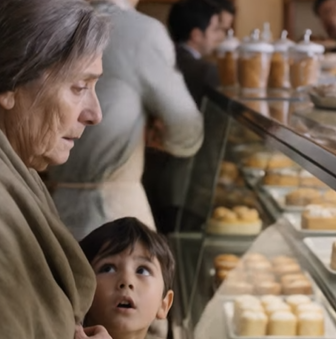
The trays.
The customers.
Even the worker who had insulted them.
The old woman stood frozen, one hand gripping the boy’s shoulder, the other trembling at her side.
The manager set the tray down slowly, unable to take his eyes off her.
“My mother never forgot you,” he said quietly. “She said if you hadn’t pushed her out that night, she would have burned with the ovens.”
The old woman’s eyes filled with tears.
“She was only seventeen,” she whispered. “I couldn’t let her die.”
The manager’s throat tightened.
Around them, the customers were listening in complete silence now.
The little boy looked from one face to the other, confused.
Then he asked the question that broke the room:
“What does that have to do with Mommy?”
The old woman covered her mouth for a second, but the sob still escaped.
The manager frowned, shaken.
“Your mother?” he said softly.
The grandmother knelt slowly despite her age and pulled the boy close.
“Your mama was with me that night,” she whispered. “She was just a little older than you are now when she first started helping me in the bakery. Years later, she came back to work beside me.”
The manager stared.
The old woman’s voice shook harder now.
“The fire started in the back ovens. I got your mother out once… but she ran back in.”
The boy’s eyes widened.
“Why?”
The old woman broke completely.
“To save the little cake she had made for your birthday.”
A gasp moved through the bakery.
Several customers covered their mouths. One woman began crying openly.
The old woman held the child tighter and whispered through tears,
“You were turning one. She didn’t want you to wake up without something sweet.”
The boy went completely still.
The manager’s face crumpled.
All these years, his mother had told him about the brave baker who pulled her from the fire.
But she had never known that the same woman had lost her own daughter in those flames.
And now that woman was standing here poor, humiliated, and insulted in front of the grandson that daughter died for.
The worker looked sick.
The manager turned slowly toward her, rage hardening his face.
“You called her a beggar,” he said. “That woman gave this city half the recipes we still bake… and buried her daughter for them.”
No one spoke.
Then the manager walked to the display and lifted the most beautiful cake in the case — white cream, strawberries, tiny sugar roses.
He added pastries.
Fresh bread.
Warm buns.
A second cake box.
And candles.
He placed everything on the counter, then knelt in front of the boy.
His voice shook as he smiled gently.
“Cakes do taste happy,” he said. “But this one tastes like love.”
The little boy stared at him with tear-filled eyes.
Then the manager went into the office and returned with an old framed photograph.
In it stood three women in flour-dusted aprons:
his mother as a teenage girl,
the old grandmother,
and a young smiling woman holding a small cake box.
The boy touched the glass with trembling fingers.
“That’s Mommy…”
The grandmother nodded, crying openly now.
“Yes,” she whispered. “She made cakes because she wanted you to have the happy childhood she never had.”
The whole bakery stood in stunned silence as the boy looked at his mother’s face clearly for the first time.
And in the place where they had been humiliated for being poor, the truth came out at last:
his mother had died not running from the fire…
but running back into it for him.