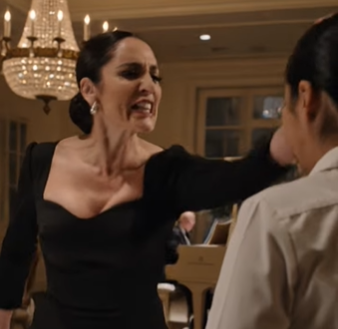
The pianist remained half-turned on his bench, pale and breathless. Guests stared openly now, forgetting their food, their manners, everything.
The rich wife slowly looked at her husband.
“You had a sister?” she whispered.
He could barely answer.
“She died as a baby,” he said.
The waitress’s eyes filled again.
“That’s what they told you.”
The room seemed to tilt.
The husband stepped forward, unable to stop staring at the locket.
He knew it.
Not from memory—
from portraits.
His mother had once kept an old painting hidden in her dressing room of a baby girl wearing that exact silver chain with the family crest. After the fire, the painting vanished.
The wife backed away from the kneeling waitress as if the floor itself had become dangerous.
The pianist spoke again, voice trembling with age and horror.
“I was playing at your family estate the night of the fire,” he said. “Your mother came downstairs holding a baby wrapped in a blanket. She told me never to speak of what I saw.”
The husband turned to him sharply.
“What did you see?”
The old man’s eyes dropped.
“I saw no smoke on the child,” he whispered. “No burns. No crying. Just your mother shaking… and blood on her sleeve.”
A gasp rippled through the restaurant.
The waitress looked down and said quietly,
“She raised me in secret with another name. She said if your father ever found out I lived, he would finish what he started.”
The wife covered her mouth.
The husband looked like all the blood had drained from his body.
“My father?” he said.
The waitress nodded, tears spilling down her face.
“He wanted a son. When your mother gave birth to a girl first, he called her useless. That night, the nursery caught fire… but your mother told me later it was no accident. She took me and ran before he could come back.”
Nobody breathed.
The rich wife stared at her husband in horror, realizing the woman she had just slapped and forced to her knees was not some jealous servant—
she was his missing sister.
Then the waitress reached into her apron pocket and pulled out a folded, yellowed letter.
“I came because she died last week,” she whispered. “And before she died, she made me promise to give you this.”
The husband took it with shaking hands.
It was written in his mother’s handwriting.
He unfolded it.
The first line nearly destroyed him:
If this letter reaches you, it means I failed to protect your sister forever.
His legs weakened.
The letter explained everything:
the father’s violence,
the staged nursery fire,
the fake burial,
the servant paid to carry out a tiny sealed coffin filled with ashes and burned blankets so the estate would believe the baby was dead.
The wife sank into a chair, white with shock.
But the cruelest line was near the end.
The husband read it aloud without meaning to:
I left the locket on her so that one day, if she survived me, you would know whose blood they tried to erase.
The restaurant was dead silent.
The pianist began crying quietly at the piano.
The wife stared at the waitress—at the woman she had dragged by the hair and humiliated in front of everyone—and whispered,
“Oh God…”
The waitress slowly stood from the floor, still shaking.
Then she looked at the wife and said through tears,
“You thought I wanted your husband. I came to return him his family.”
No one could speak after that.
Not after the dead sister.
Not after the fake fire.
Not after the mother’s confession.
And under the crystal chandeliers, in the glow of expensive candlelight, the richest table in the restaurant collapsed into absolute ruin—
because the woman kneeling on the floor had never been the shame of that family.
She had been the child they tried to bury alive.