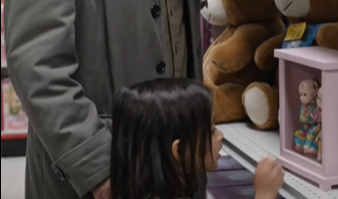
The manager looked at the old man as if the past had just stepped out from behind him.
His voice shook.
“What was her name?”
The grandfather’s jaw tightened.
For a second, it looked like he might turn and leave.
Then he answered.
“Elena.”
The manager staggered back half a step.
That name had lived in whispers in his family for twenty years.
His grandfather, the founder, had died believing his daughter betrayed him.
His father had spent years hating the sister he had never found.
And every Christmas, hidden away in old storage, there was one unfinished display marked with her initials.
E.L.
The manager looked at the child.
“And your mother… was Elena?”
The little girl nodded, confused.
The grandfather’s voice came out rough.
“She was accused of stealing prototype dolls after money went missing from the company safe. Your family threw her out before she could defend herself.”
A gasp ran through the nearby customers.
The employee who had insulted them looked sick now.
The manager whispered,
“That’s not what we were told.”
The old man’s eyes hardened.
“Of course not. Rich families prefer cleaner lies.”
Nobody moved.
The old man reached into his coat slowly and pulled out a folded, yellowed envelope, worn thin at the corners.
“I kept this because she asked me to,” he said.
The manager took it with trembling hands and opened it.
Inside was a sketch.
A music-box doll in a pale blue dress.
The exact doll the little girl had been staring at.
Below it, in faded handwriting, were the words:
For my daughter, so she will know I never stole from her.
The manager’s face crumpled.
He turned the page.
Behind the sketch was an old receipt from the founder himself — proof that the money missing from the safe had been withdrawn by his own accountant two days before Elena was blamed.
The store swayed in silence.
The grandfather’s voice broke for the first time.
“She begged them to listen. She stood in this same store crying while people watched. No one defended her. Not one of you.”
The manager looked like he had been struck.
“She died?” he asked quietly.
The old man closed his eyes.
“She worked herself sick trying to raise this child after your family buried her name.” He looked down at his granddaughter. “And when she was dying, she made me promise one thing: that her daughter would one day hear the music-box song and know her mother told the truth.”
The little girl stared at the doll with tears in her eyes.
That was why her mother used to sing about it.
It had never been just a toy.
It was the last piece of her name.
The manager turned slowly toward the employee, rage boiling in his face.
“You just humiliated the daughter of the woman who designed half the dolls in this store.”
The employee opened her mouth, but nothing came out.
Then the manager did something that froze the entire room.
He unlocked the glass case, took out the music-box doll, and knelt in front of the little girl.
With shaking hands, he turned the tiny handle.
A soft melody filled the store.
The child’s lips parted.
“That’s Mommy’s song…” she whispered.
The manager was crying openly now.
He placed the doll in her arms and said,
“It always was.”
Then he stood, turned to the customers, and said in a voice everyone could hear:
“My family called an innocent woman a thief and built this store on her silence. Starting today, her daughter’s name goes back where it belongs.”
He walked to the front wall where the founder’s portrait hung.
Beneath it was a brass plaque.
He removed it.
And in front of the whole store, he said the words that shattered everyone:
“This place was never built by one founder. It was built by two.”
The grandfather covered his face, shaking with emotion.
The little girl held the doll against her chest like she was holding her mother one last time.
And around them, in the bright toy store where they had been humiliated only minutes earlier, people stood in stunned silence as a dead woman’s stolen name was finally given back to her child.