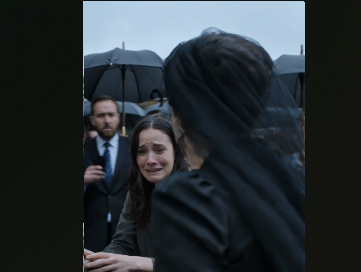
The widow stood frozen beside the coffin, one gloved hand trembling against the black silk of her dress.
The priest bent slowly, picked up the ring, and turned it over.
Inside, beneath years of wear, there was an engraving:
For Elena — before God, before death.
The old priest shut his eyes.
“I blessed this ring myself,” he whispered. “And I watched it placed into her coffin.”
The poor woman’s tears fell harder.
“But it was not there when my mother died,” she said. “She wore it on a chain under her clothes. She said he came to her in secret and put it around her neck the night I was born.”
A murmur moved through the mourners.
The widow’s face drained of color.
The dead man’s brother looked at her.
“You told us Elena died before there was any child.”
The widow turned sharply.
“There was no child.”
The poor woman laughed once through tears, and it sounded broken.
“That lie buried my mother while she was still alive.”
Every head turned back to her.
The priest’s voice shook.
“Your mother was Elena?”
The woman nodded.
“She survived,” she whispered. “She fled after your family locked her in the church cellar when they found out she had given birth.”
A collective gasp hit the churchyard.
The coffin bearers looked at each other in horror.
The brother stepped back as if struck.
“No…”
The woman reached into her coat again and pulled out a folded yellowed letter, edges worn thin with time.
“My mother told me to open this only over his body,” she said.
The priest took it with trembling hands and read aloud because the dead man’s brother could no longer trust his own voice.
The first line shattered the funeral:
If this letter is being read, then he let them bury his silence with him.
The widow covered her mouth.
The letter went on:
Elena had not died.
She had been hidden after childbirth.
The family feared scandal because the husband had secretly married her before he was married again for money and title.
The widow’s powerful family forced the second marriage to protect inheritance and land.
The child—this poor grieving woman—was taken away and raised under another name.
Then came the cruelest line:
He stole the ring from my coffin before the empty burial, so one day our daughter would know I was his first and only true wife.
The churchyard seemed to tilt.
Empty burial.
The brother stared at the priest.
“Empty?”
The priest’s face collapsed.
He whispered,
“The coffin was sealed before it reached the altar. I was told her body had been burned beyond viewing.”
The poor woman looked at the widow, grief and fury burning together in her face.
“My mother said you stood outside the room while they took me.”
The widow’s knees nearly gave out.
“I was saving this family,” she whispered.
“No,” the woman said. “You were burying mine.”
Then the dead man’s brother reached toward the coffin blanket and froze.
Tucked beneath the lilies was a second envelope.
His brother’s handwriting.
The priest opened it.
Inside was a single sentence:
Bury me beside Elena, or let the whole town know who my widow helped erase.
The mourners erupted into horrified whispers.
Phones lowered now.
No one was filming for gossip anymore.
They were staring at the widow like she had dragged rot into a holy place.
The poor woman stood beside the coffin, crying openly now, and whispered,
“He came to see me three times in secret. Every time he promised he would tell the truth. Every time he went back to her house and stayed silent.”
The priest placed the gold ring back onto the coffin lid and said,
“This funeral cannot continue as a lie.”
And under the gray sky, outside the stone church, the truth finally broke open:
the poor woman dragged by the hair from the coffin was not some hidden shame—
she was the daughter of the first wife they buried without a body,
while the widow stood over a husband who carried his first marriage to the grave.