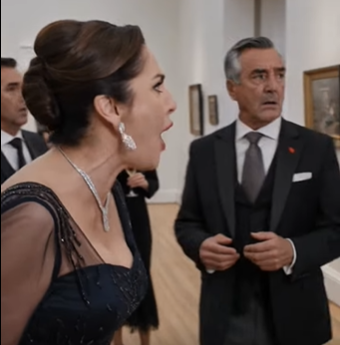
The room erupted.
“What child?” the rich wife snapped, but her voice no longer sounded powerful. It sounded afraid.
The curator slowly unfolded the yellowed letter with trembling hands. The paper was brittle with age, the ink faded, but the signature at the bottom was unmistakable.
It belonged to the husband’s mother.
He stopped breathing.
“No…” he whispered.
The curator read aloud:
“If anything happens before the wedding, protect the baby. He must never know until the portrait is shown to him.”
The husband grabbed the letter from his hands and stared at the signature. His face drained of color.
His wife stepped back.
The guests looked from the letter… to the portrait… to the assistant.
The assistant was crying openly now.
“My mother never wanted your money,” she said. “She never wanted revenge. She only said one day the truth would have to survive longer than the lie.”
The husband turned to her slowly. “Your mother… where is she?”
The assistant swallowed hard.
“She died three months ago,” she whispered. “But before she died, she gave me this.”
From inside her sleeve, she pulled out a small velvet pouch.
Inside it was a second ring.
Not similar.
Matching.
An engagement ring set engraved with the same family crest and one hidden date.
The date of the wedding that never happened.
The rich wife staggered backward. “This is a trick—”
“No,” the curator said quietly. “I remember that set. One ring was for the groom. One was for the bride. After she vanished, only one remained.”
The husband looked down at the ring around his own neck… then at the ring in the assistant’s trembling hand.
Two halves of the same promise.
Then the assistant delivered the final blow.
“My mother wasn’t the woman in the portrait,” she said.
The husband looked up, confused.
The entire room froze again.
The assistant pointed toward the rich older woman standing near the back of the gallery — the woman who had insisted all night that the portrait never be shown.
And in a voice barely above a whisper, she said:
“She was.”