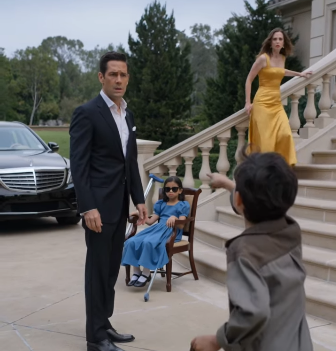
“He’s lying.”
That was her first mistake.
Not because of the words. Because of the speed. Innocent people are confused first. Frightened people defend first.
The father still didn’t answer her.
He was staring at the bottle in his hand, then at his daughter, then at the barefoot boy now standing in the middle of his driveway like a witness nobody had invited but somebody had needed.
“How do you know?” the father asked.
The boy swallowed.
“I sleep by the back wall,” he said. “Near the kitchen bins. The windows were open.”
The wife closed her eyes for one second.
Too late.
The father saw that too.
The boy kept going, voice shaking now but steady enough.
“I heard her tell the cook the bitter one works better if the girl drinks it before food. She said if she complains, tell her it helps her eyes rest.”
The father crouched in front of his daughter.
The little girl gripped the crutch tighter.
“Look at me,” he said softly.
The child’s lips trembled.
The wife stepped down one stair. “Stop this right now—”
“Look at me.”
A long second passed.
Then the girl did.
Not toward his voice.
Directly at his face.
The father’s expression emptied.
The wife stopped moving.
The little girl began to cry without making sound.
“Mama said I had to,” she whispered.
The father did not blink.
“Had to what?”
The child stared at the ground.
“Pretend.”
The word landed harder than the accusation.
The boy pointed at the bottle. “She dropped one near the hedge yesterday. I kept it because she came back looking for it.”
The father rose to his feet very slowly.
Now when he looked at his wife, it was not with confusion.
It was with recognition.
Not of what she had done.
Of how long she had been doing it.
Then the little girl said the part that turned the lie into motive:
“Mama said I only have to stay blind until the papers are signed.”
The wind moved lightly across the driveway.
No one spoke.
Because suddenly the bottle was not just medicine.
It was evidence.
And the father understood that his daughter’s illness had been timed.