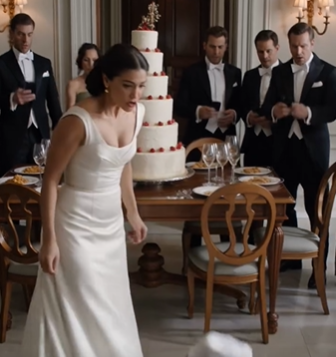
Doctors came and went through private entrances. The father paced the upstairs hall in silence. The mother screamed through labor behind closed doors while the family prepared to celebrate the birth of the baby who would secure everything — the fortune, the name, the inheritance.
Before sunrise, the official story was announced.
The newborn had died.
No one was allowed to see the body for long.
The mother was heavily sedated.
The nursery was cleared.
The subject was buried.
The family moved on.
But the servant kneeling on the floor had never moved on.
That night, the father called her into a private room and gave her a bundle wrapped in blankets, along with money, forged papers, and one command:
Disappear.
Raise the child far away.
Never come back.
At the time, she thought she was carrying the baby his wife had just given birth to — the child the world had been told was dead.
But years later, after the father secretly contacted her again, she learned the truth that had poisoned his soul ever since:
the baby he handed her was not his wife’s newborn at all.
There had been two infants in the house that night.
One was the wealthy wife’s baby.
The other was a second child born in secret to a young woman the father had loved years before — a woman the family had erased before the marriage ever happened.
When the birth turned dangerous and panic took over, someone inside the house made a monstrous decision.
The wrong child was declared dead.
The wrong child was sent away.
And the real baby born to the wife stayed in the mansion, raised as the legitimate daughter everyone now knew.
That was why the father had gone pale at the bracelet.
Because it belonged to the child he had hidden — not the child his wife believed she had lost.
The trembling older woman in the crowd, who had recognized the date, finally broke down crying.
She had been the night nurse.
She confessed that she had seen the babies switched after the mother lost consciousness, but she had been threatened into silence and told that if she spoke, both children would die.
The rich daughter’s face went white.
Because for the first time in her life, she understood what the servant was really saying.
She might not be the woman her mother gave birth to.
The father could barely hold the bracelet now.
His hands shook so violently that the guests stepped back from him.
Then the servant reached into her pocket and pulled out one more thing:
a faded photograph of a little girl wearing that same bracelet, standing beside a birthday cake in a modest apartment.
On the back were words written in the father’s own hand:
“Forgive me. I sent away the wrong child.”
The daughter stared at the photo, then at her father, then at the servant.
Her voice cracked.
“Who was I?”
The servant’s tears fell harder.
Then she said the line that destroyed the entire room:
“You were the baby his wife never gave birth to.”
The father closed his eyes.
Because the truth was even uglier than anyone feared.
His wife’s real newborn had died that night.
But rather than lose the heir, the family replaced the dead baby with another living child — and built an entire life, inheritance, and family lie on top of that switch.
Then the servant looked at the daughter one last time and delivered the final line that shattered the mansion:
“He didn’t bring me back tonight to confess that he lost a child.”
Everyone stared at her.
And she finished:
“He brought me back because the girl who should have inherited this house is already standing in this room… serving your drinks.”