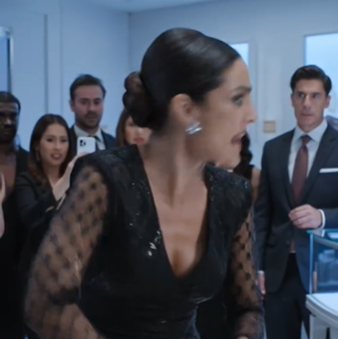
His first bride was beautiful, quiet, and deeply in love with him. Their wedding had been arranged quickly, surrounded by wealth, power, and family pressure. To the public, they looked perfect.
But days before the ceremony, she found out something that changed everything.
She was pregnant.
And when certain people in the family learned that the child might threaten inheritance plans, panic began behind closed doors.
Then came the fire.
A woman’s body was found.
The wedding was canceled.
The family announced the bride was dead.
The diamond ring was said to have been buried with her.
No one questioned it.
No one except the girl’s mother.
She had once worked as a seamstress and dresser inside the same family circle. On the night of the fire, she saw the first bride injured but alive, trying to remove the ring from her finger and force it into her hand. She kept repeating one sentence through smoke and blood:
If they bury me, it won’t be me.
The woman escaped with the ring.
But she could not save the bride.
Before dying years later, she told her daughter the truth:
the woman buried after the fire was not the first bride at all, but another woman used to close the scandal and seal the lie. The real bride had survived that night long enough to disappear — and long enough to protect the child she was carrying.
That child was the sales girl.
Now the elderly jeweler took the old ring with shaking fingers and turned it slowly under the light. Hidden inside the band was the private engraving he had placed there himself years ago:
To my first and only bride.
The fiancé’s knees nearly gave out.
Because only he, the jeweler, and the missing bride had ever known those words existed.
The rich woman who had done the slapping stepped back in horror.
Because suddenly this was no longer about theft.
It was about a dead bride returning through the face of her daughter.
Then the sales girl pulled one more thing from her pocket:
a scorched photograph.
In it, the missing bride stood beside the fiancé, one hand over her stomach, the other holding the same ring before the fire.
On the back, in faded handwriting, were the words:
If my daughter ever brings this back, tell him I was never the one they buried.
The boutique stopped breathing.
The fiancé looked at the girl’s face again — her eyes, her mouth, the way she trembled when trying not to cry — and saw the woman he had lost.
Then the sales girl said the line that shattered the room:
“My mother didn’t send me here to return the ring.”
Everyone stared at her.
And she finished:
“She sent me here because the woman who helped bury the wrong bride is standing beside you.”