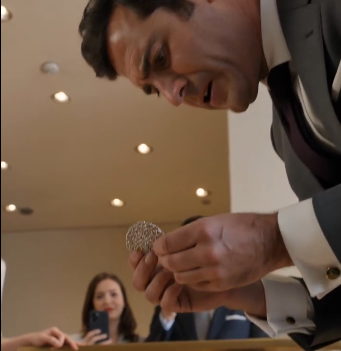
She was delicate, poor, and deeply loved by his son — the man now standing in the boutique with the shaking brooch in his hand.
Their relationship was hidden because the family refused to accept her. But she gave birth to twin daughters in secret, and for one brief moment, the father believed he would protect all three of them.
Then came the fire.
It tore through the old family estate on a stormy night. By morning, the official story was already prepared: the mother was dead, one daughter had died with her, and only one child had survived.
The family locked away the jeweled brooch that had belonged to the mother, because it was found near the burned nursery and became the symbol of a tragedy no one wanted discussed again.
But the truth was never that simple.
The cashier had grown up in poverty with her mother’s name spoken only in whispers. Before dying, the woman who raised her finally confessed everything: she had been the family nanny the night of the fire, and she had taken one of the twin girls to save her.
But she was never sure whether she had carried out the daughter the family wanted saved… or the one they meant to erase.
That was why she kept the brooch hidden all those years.
Inside the jewel’s back plate was a tiny engraving only the true father would recognize.
The husband’s hand was shaking because he had read it now.
It said:
For Elena’s second daughter — the one with my eyes.
No one else in the room understood at first.
But he did.
The twins had not been identical.
One had her mother’s dark eyes.
The other had his pale grey eyes.
And the girl standing in front of him, crying behind the counter, had his eyes.
The older owner collapsed into a chair because he suddenly understood what the dead woman had done before the fire: she had pinned the brooch to the wrong blanket on purpose, hoping that if anyone used it to identify the child, they would protect the daughter she feared would be less wanted.
The rich woman who had done the slapping stepped back in horror.
Because this was no longer about theft.
It was about a child returned from a grave that should have been empty.
Then the cashier reached into the torn lining of her scarf and pulled out one more thing:
a half-burned photograph.
In it, the dead woman was holding two baby girls beside the same jeweled brooch. On the back, in faded handwriting, were the words:
If only one is named dead, the wrong one was chosen.
The husband could barely stand now.
He looked at the cashier’s face, her eyes, the shape of her mouth, and saw the woman he had loved in her so clearly that it stole the air from his lungs.
Then the cashier said the line that shattered the boutique:
“My mother didn’t send me here to return your brooch.”
No one moved.
And she finished:
“She sent me here because the daughter you mourned is alive… and the one you raised was never the one taken from the fire.”