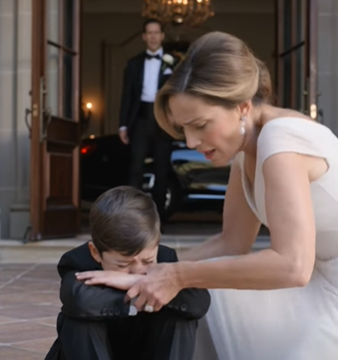
Because the moment the boy pointed at the bride, every person on those steps understood the same thing:
this was no tantrum,
no childish confusion,
no badly timed outburst.
This was a child deciding silence had become more dangerous than punishment.
The older woman was still kneeling beside him, unable to stop staring at the wound around his wrist.
“Who did this?” she asked softly.
The boy’s mouth trembled.
He didn’t answer her.
He kept looking at the groom.
The bride, still near the doorway, tried to recover first.
“That child is upset,” she said. “He doesn’t know what he’s saying.”
But her voice came too fast.
Too polished.
Too ready.
The groom heard it.
And for the first time since stepping outside, he did not look at the boy.
He looked at her.
Really looked.
At the backward step.
At the fear in her face.
At the fact that she had not asked what happened to the child’s wrist.
Then the boy whispered again:
“She said if I showed you, the little girl wouldn’t come home.”
The groom’s expression changed instantly.
Not confusion.
Recognition.
Because there was a little flower girl missing from the bridal room.
A child everyone had assumed was with the makeup team. Or asleep. Or somewhere harmless in the noise and silk of the day.
The older woman looked up sharply.
“What little girl?”
The boy swallowed hard.
“My sister.”
The bride went pale.
The groom stepped down one stair.
Very slowly.
That made it worse.
Because anger would have looked human.
This looked like understanding.
The boy lifted his injured wrist slightly, as if it embarrassed him now that it was visible.
“She tied my hand when I tried to open the side room,” he whispered. “She said if I kept crying, she’d lock her in there until after the vows.”
The air on the steps changed.
Not loud.
Just deadly quiet.
The groom’s eyes moved from the boy’s wrist to the open doorway behind the bride.
Then to the dark corridor beyond the flowers and candles.
The bride shook her head once, weakly. “It isn’t like that.”
Wrong sentence.
Because innocent people explain the child.
Guilty people explain the danger.
The older woman rose slowly to her feet.
“Where is the girl?” she asked.
The boy looked at the groom, not the women, not the church, not the wedding car—
only the groom.
And then he said the sentence that shattered whatever ceremony was still alive:
“Behind the blue door with the ribbon on the handle.”
The groom didn’t speak.
He just looked past the bride—
toward the hallway inside—
where, for the first time, everyone noticed a strip of pale decoration hanging from a closed side door that should have been open all morning.