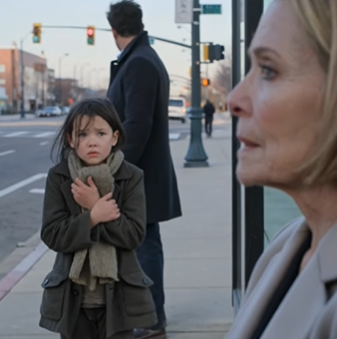
The man did.
He stared at the stitched initials inside the scarf, then at the woman, then back at the child, and the color did not return to his face.
“What do those letters mean?” he asked quietly.
The girl hugged the scarf tighter.
“My mom said if I ever saw that ring,” she whispered, “I had to show this first.”
The old woman shut her eyes.
For one long second, no one spoke.
The bus stop stayed unnaturally quiet — only wind, distant traffic, and the metallic clatter of a bus somewhere too far away to matter yet.
The man stepped closer. “Those initials are not a name.”
He was right.
They were not initials sewn like a child’s clothing label.
They were stitched like a mark.
A claim.
The old woman looked at the girl and said, very softly, “Who was your mother?”
The child swallowed hard.
“Lena.”
The name hit the woman like a blow.
Not surprise.
Recognition.
The man noticed immediately.
“You know her.”
The old woman nodded once, slowly.
“She worked in my house many years ago,” she said.
The girl’s eyes filled with desperate hope. “Then where is she?”
The woman’s silence answered before her mouth did.
The child’s face began to break.
The man carefully held out a hand. “May I see the scarf?”
After a pause, the girl passed it to him.
He turned the hem over and looked more closely.
The stitches were not random.
They formed two letters and a tiny crown shape above them.
He looked up sharply.
“This was made in the Valecourt house,” he said.
The old woman did not deny it.
The girl frowned through tears. “What does that mean?”
The man looked at her, then at the woman, as though deciding whether saying it aloud would make everything worse.
But the woman answered first.
“It means your mother didn’t keep that scarf because she was poor,” she said. “She kept it because she cut it from something she was never supposed to take.”
The little girl stared.
The old woman’s voice shook now.
“That scarf was part of a baby blanket.”
The world seemed to go still around them.
The girl’s fingers loosened.
The man looked back at the stitched mark and understood before the child did.
The crown.
The letters.
The matching ring.
This was not just household embroidery.
It was family insignia.
The little girl whispered, “My mom said it belonged to me.”
The old woman’s face collapsed.
Then, with real fear in her voice, she said:
“If she told you that…”
She looked toward the road, then back at the child.
“…then she must have finally told you whose child you were carrying it for.”