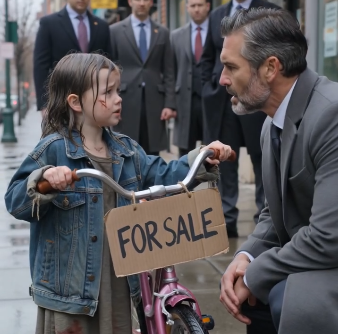
That was the first thing that confused the girl.
Most adults either walked away or paid quickly just to escape the sadness. But this man kept looking at the bike, then at the men, then back at her with the expression of someone no longer hearing a sad story — someone seeing a pattern.
The four men in the background did not come forward all at once.
That made them worse.
Because people who mean trouble and know they own the timing never hurry.
The man kept his voice low.
“Who are they?”
The little girl’s lips trembled. Rain slid down her cheek and mixed with tears.
“They came after my dad died,” she whispered. “They said the shop belongs to them now.”
The man looked toward the old storefront behind her.
Its shutters were half rusted. The sign was faded. Easy to miss.
Easy to take.
The girl swallowed hard.
“They said Mommy can stay inside if I help.”
The man’s face hardened.
Not loud anger.
Something quieter.
Much more dangerous.
He looked again at the bicycle seat, then bent slightly lower.
The white cloth tied beneath it wasn’t random after all.
It was a torn piece of hospital bandage.
Wrapped around a tiny key.
He looked up at her.
“What does this open?”
The girl’s breathing hitched.
She glanced toward the four men.
Now two of them were moving.
Slowly.
“They don’t know I took it,” she whispered. “Mommy hid it on my bike.”
The man understood at once.
This was never just a child selling her bicycle for food.
This was a child being sent into public with the one thing four grown men were waiting to get back.
The nearest suited man stopped a few paces away.
“You buying the bike?” he asked.
Too calm.
Too smooth.
The little girl flinched so slightly most people would have missed it.
The man in the overcoat did not.
He stood up slowly, but kept one hand on the bicycle.
That changed the whole frame.
Now it no longer looked like a sale.
It looked like a line being drawn.
The suited man smiled without warmth. “That’s family business.”
The little girl whispered, almost soundlessly:
“No, it’s my house key.”
The man in grey did not look at her.
He kept his eyes on the suited man and asked, very quietly:
“Which family?”
No one answered.
That silence answered enough.
Because suddenly the soaked cardboard sign, the starving mother, the dead father, the four men by the shop, and the key hidden under a child’s bicycle all became one thing:
not poverty,
but pressure.
Not a sale,
but a trap.
And the girl realized, for the first time since she walked onto that sidewalk, that the man in front of her had not stopped because he felt sorry for her.
He had stopped because he saw what the others were pretending not to show.