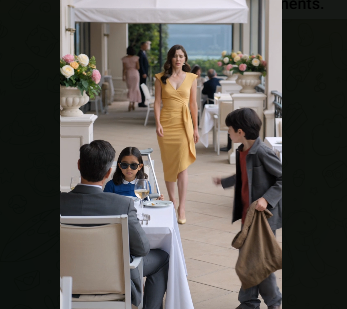
The father stayed on the bench, bottle in hand.
The daughter sat beside him, too frightened to move.
The boy stood opposite, sack still open.
And the wife remained near the hospital doors, far enough to seem separate, close enough to be trapped.
The whole truth was visible at once.
“He’s lying,” the wife said first.
Too fast.
The father did not even look at her.
He stared at the bottle, then at his daughter, then at the boy — no longer like a trespasser, but like a witness who had arrived from the edge of the world carrying the one thing the family could not hide.
“How do you know?” the father asked.
The boy swallowed.
“I sleep near the back wall,” he said. “By the children’s wing bins. I hear things.”
The wife’s face tightened.
Wrong move.
The father noticed.
The boy kept going.
“She cried yesterday,” he said. “A nurse said she should be getting better. Your wife said, ‘Not yet.’”
The father turned to his daughter again.
His voice softened, which made it worse.
“Can you see me?”
The girl’s fingers locked tighter around the crutch.
She did not answer.
The wife took another small step back.
“Can you see me?” he asked again.
A long second passed.
Then the little girl nodded.
The father stopped breathing.
In the background, the wife looked toward the doors like she was measuring the distance.
The child’s mouth trembled.
“She said not to tell you,” she whispered. “She said if you knew too early, we couldn’t stay here.”
The father finally looked up at his wife.
Not with anger.
With horror.
Because now he understood the sickness had a schedule.
The blindness had a purpose.
And the bottle in his hand was not treatment.
It was timing.
Then the little girl said the line that shattered whatever hope the wife had left:
“She said when you sign, I can stop pretending.”