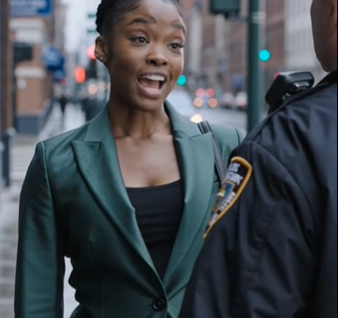
The city noise around them felt far away now.
The woman in the emerald suit stood perfectly still, badge in one hand, photograph in the other, while the truth he had buried came walking back toward him in broad daylight.
He stared at the photo.
Then at her.
Then back at the photo again.
Because he remembered that day.
A boy on a sidewalk.
Too young.
Too frightened.
In the wrong place only because someone decided he was.
And now the boy’s mother was standing in front of him with federal credentials and eyes that had clearly waited a year for this moment.
His voice came out weak.
“I… I don’t know what you’re talking about.”
She gave the smallest nod.
Like she had expected the lie.
Then she unfolded a second paper and handed it to him.
His own incident report.
Only now, every line he had written was marked in red.
False location.
False resistance.
No bodycam footage submitted.
The officer’s hand began to shake.
The woman stepped closer, but never raised her voice.
“You thought he was just another kid you could scare,” she said.
“Just another name nobody would check.”
He looked over her shoulder, desperate now, like he wanted someone to interrupt.
No one did.
Because at the far curb, an unmarked black SUV had just stopped.
Two people were already stepping out.
He saw them.
And his stomach dropped.
The woman saw him notice.
Good.
That was exactly when she let the rest of the truth land.
“My son wasn’t resisting that day,” she said quietly.
“He was trying to tell you he was diabetic and about to collapse.”
The officer went pale.
Because he remembered that too.
The boy’s shaking hands.
The panic.
The way he kept saying, please listen.
He remembered ignoring it.
The woman’s face didn’t harden.
It hurt more than that.
It broke.
Just slightly.
Enough for him to see that this was not only about justice.
It was grief sharpened into purpose.
Then she said the line that made his knees almost give out:
“He survived the arrest.”
A pause.
Then:
“He didn’t survive the ride home.”
The officer stopped breathing for a second.
The two federal agents crossed the street behind her.
Not rushing.
They didn’t need to.
He was already trapped.
The woman lowered the photograph.
Rainwater slid from a strand of hair near her temple, but she never wiped it away.
“So no,” she said.
“You’re not arresting me.”
The agents reached them.
One of them opened a file.
The other read him his rights.
And the officer, standing on the same kind of sidewalk where he once decided someone else didn’t belong, finally understood what real fear felt like.
The woman took one step back and watched in silence.
Then, just before they turned him toward the black SUV, she said one final thing:
“Next time you stop someone for being where they ‘don’t belong’…”
He looked at her.
Her eyes were colder than the weather.
“…make sure it isn’t the mother of the child you buried under paperwork.”
The end.