Forgot the customers.
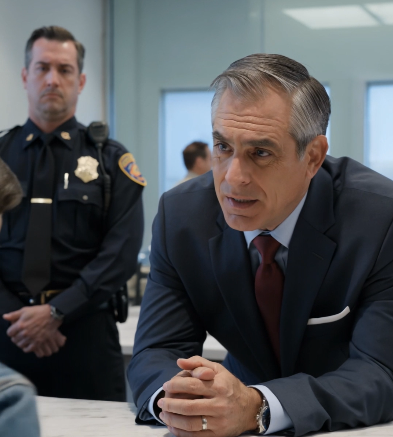
Forgot the guard.
Forgot the cameras.
All he could see was that note in his hand.
The boy stood perfectly still on the other side of the counter, watching him with the kind of frightened patience only children develop when adults keep hiding the truth.
The teller folded the note once and slipped it beneath the documents.
Then he leaned forward and lowered his voice.
“Did anyone follow you here?”
The boy hesitated.
Then nodded.
“A black car,” he whispered.
“It stayed behind our bus for three stops.”
The teller’s pulse jumped.
He glanced toward the glass entrance.
Nothing obvious.
But that meant nothing.
He looked back into the sack.
The gold coins were not the most valuable thing there.
The documents were.
Because now he recognized them too.
Property transfers.
Offshore account instructions.
Names that had been buried under shell companies and dead signatures.
And at the bottom of one page—
the signature of a man who was supposed to have died fifteen years ago.
The teller took a slow breath.
Then opened the antique pocket watch.
Inside the lid was an engraving.
Box 317. Ask for Martin. Trust no uniform.
The teller closed it immediately.
Too late.
The security guard had started walking toward them.
The boy noticed first.
His eyes widened.
The teller smiled like nothing was wrong and said louder, for anyone listening:
“Just some old family keepsakes. One moment.”
Then under his breath:
“Do not look at the guard.”
The boy went still.
Because the teller had just confirmed what his father clearly feared:
someone inside the bank could not be trusted.
The guard stopped a few feet away.
“Everything okay here?”
The teller looked up calmly.
“Perfectly fine.”
But his hand had already moved below the counter to an old silent switch most employees didn’t even know still worked.
Not an alarm for the police.
A private call line.
One tied to Box 317.
The guard’s eyes dropped briefly to the bag.
Too brief for most people to notice.
Long enough for the teller to understand.
He knew.
The boy gripped the edge of the marble counter, trying not to panic.
Then the teller pulled one document free, turned it slightly toward himself—
and felt his stomach drop.
Because clipped to the back was a small photograph.
A picture of the boy as a toddler.
Standing beside his father.
And beside them—
the very same security guard now standing three feet away.
The teller looked up slowly.
The guard’s face did not change.
That was worse.
Because it meant he already knew the photograph was there.
The boy saw the teller’s expression and whispered:
“What is it?”
The teller did not answer him directly.
He looked at the guard and said the one sentence that turned the entire bank into a silent trap:
“You should never have come out from behind the photo.”
The guard’s hand moved toward his jacket.
Customers in line still had no idea anything was wrong.
The teller grabbed the sack, leaned over the counter, and said sharply to the boy:
“Run to Box 317. Martin is downstairs.”
The boy froze.
“Go!”
And just as the guard lunged forward—
the old pocket watch in the teller’s hand clicked open by itself, revealing one final hidden inscription beneath the inner plate:
THE KEY IS THE BOY.
The end.