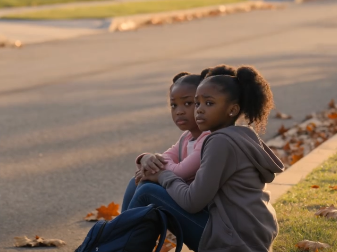
The girls looked at the backpack.
Then at each other.
Then back at their aunt.
The younger one’s lip started trembling.
Because now even she understood:
this was no longer about someone calling the police on two Black girls sitting on a curb.
Now it was becoming something worse.
The officer stepped forward and pointed at the bag.
“I checked the outer tag,” he said. “Different last name.”
The woman’s jaw tightened.
“You went through their things?”
The officer ignored that.
The older girl stood slowly, trying to be brave.
“That’s not ours,” she whispered.
The woman turned to her immediately.
“What do you mean?”
The girl swallowed hard.
“Our bus driver told us to grab the blue bag from under the seat and wait here. He said you’d know.”
The woman went still.
Because she had never told any bus driver where the girls would be waiting.
And suddenly the backpack stopped looking random.
Stopped looking misplaced.
Started looking planted.
The officer frowned.
The woman knelt beside the girls and unzipped the bag carefully.
Inside were children’s clothes.
A juice box.
A folded school worksheet.
And under them—
a small silver tablet.
Not a toy.
A real device.
The woman picked it up.
The screen lit instantly.
One new video file.
No label.
No sender.
The officer leaned in.
The older girl grabbed her aunt’s sleeve.
“Don’t play it,” she whispered.
But the woman already had.
The screen opened to shaky footage from inside a school hallway.
Children walking.
Teachers passing.
Then the camera stopped at a classroom door.
A man’s voice whispered off-screen:
“Those are the two.”
The woman’s blood ran cold.
Because the next frame showed the two girls.
Her girls.
Leaving school that afternoon.
The officer’s face changed now too.
No more impatience.
No more easy assumptions.
Because this was not about trespassing.
This was about surveillance.
The woman looked up at him sharply.
“I told you they were waiting for me.”
But she was not really speaking to him anymore.
She was thinking faster now.
Bus driver.
Wrong backpack.
Video already loaded.
Someone wanted those girls found before she got here.
Then the younger child said the thing that shattered the last illusion of safety:
“The bus driver wasn’t our normal one.”
Silence.
The officer stared at the tablet.
Then back at the street.
At the dark house behind the blinds.
At the caller who had reported “two suspicious girls” almost the moment they sat down.
His whole posture changed.
Because now he understood:
the phone call may not have been fear.
It may have been a signal.
The woman slowly stood, keeping one arm around both girls.
“Get them in my car,” the officer said.
She didn’t move.
He looked at her directly.
This time, no arrogance.
No suspicion.
Only urgency.
“Now.”
The blinds in the dark house twitched again.
Just slightly.
And all three of them saw it.
The officer’s hand went to his radio.
Because suddenly the quiet suburban street didn’t feel quiet anymore.
It felt watched.
The end.