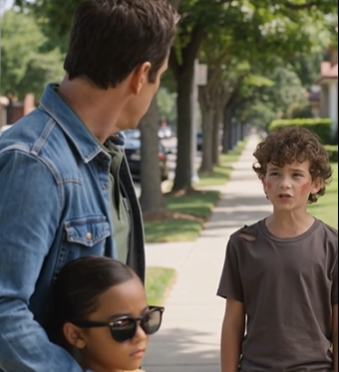
The bright suburban street suddenly felt too open, too public, too ordinary for what was happening in it.
“What does he mean?” he asked.
The girl gripped the cane tighter.
Her lips trembled.
But she still didn’t answer.
The boy stayed calm, scratched face turned toward the man like someone who had already decided the truth was worth getting hit for.
“You keep asking doctors what happened to her eyes,” he said quietly. “You should’ve been asking what happened in your house.”
The father’s expression shifted.
Not just anger now.
Fear.
Because some part of him had already lived with that question in silence.
He crouched slightly in front of the girl.
“Look at me,” he said softly.
She didn’t.
That was the first real answer.
Then the boy said, “She can see you. She just can’t look at you without seeing her mother fall.”
The father went white.
The girl made a small sound in her throat — the kind children make when someone opens a locked room inside them too quickly.
“What fall?” he whispered.
The boy looked at her, not him.
“Tell him.”
The girl’s breathing shook.
Finally, in a tiny voice, she said:
“The stairs.”
The father stopped moving.
Not because he understood fully.
Because he understood enough.
The boy continued, his voice low and steady now.
“She told the nurse your wife said blind was better,” he said. “Blind children don’t describe what they watched.”
The man turned toward the scruffy boy like the world had tilted under him.
“Who are you?” he asked again.
This time the boy answered.
“I was there.”
A beat.
“My mother cleaned your house.”
And the girl, still trembling, whispered the line that destroyed whatever lie was left:
“She pushed my mom… and told me if I ever looked at you again, I’d be next.”