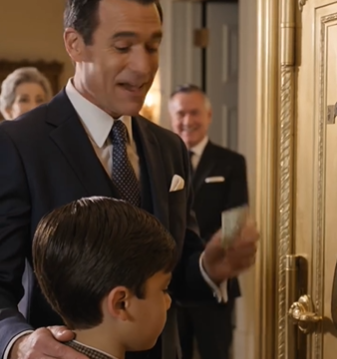
The laughter was gone.
The performance was gone.
All that remained in the room was the boy, the safe, and the expression on the man’s face — the expression of someone who had just realized the trap was no longer his.
The woman in the background stepped forward first.
“Excuse me?” she said quietly.
The man recovered fast, but not fast enough.
“That’s absurd,” he said. “He’s bluffing.”
The boy looked at the safe, then back at the woman.
“Third shelf,” he said. “Inside the blue velvet watch box. Under the false bottom.”
The woman went pale.
Because there had been a missing necklace.
Not just expensive.
Personal.
An heirloom emerald-and-diamond piece that vanished three months earlier, the same week the household maid was accused of stealing from the family and dismissed without references.
No proof.
No recovery.
Just whispers.
And the man standing beside the boy saying the servants could no longer be trusted.
The older gentleman at the back of the room spoke at last.
“Open it.”
The well-dressed man turned sharply. “Father, this is ridiculous—”
“Open it.”
This time there was no room left for refusal.
With too many eyes on him now, the man walked to the safe, entered the code with visibly unsteady fingers, and pulled the heavy door open.
Warm light struck the gold shelves inside.
First shelf. Papers.
Second shelf. Cash boxes.
Third shelf.
A blue velvet watch box.
No one moved.
The woman stepped closer herself, lifted the box, opened it, and froze.
Then her hands began to shake.
Slowly, she reached inside, pulled away the false bottom…
and revealed the missing necklace.
A sound tore through the room — not quite a scream, not quite a gasp.
The man’s face lost all color.
The woman turned toward him as if she no longer recognized the person she had spent years standing beside.
“You told me the maid stole this.”
He opened his mouth, but nothing came out.
The boy’s voice was soft now.
“She didn’t steal it,” he said. “She saw him hide it after the insurance papers were signed.”
The older man — the patriarch of the family — stared at his son with something colder than anger.
Because suddenly this was no longer only about jewelry.
It was fraud.
A false accusation.
A servant thrown out.
A household lie.
And then the boy delivered the one line that made everything worse:
“That’s not why he really wanted me to fail.”
The room turned toward him again.
The boy looked directly at the old man.
“He wanted everyone laughing,” he said, “before I told you what’s in the envelope behind the bottom drawer.”
The patriarch went still.
Because there was an envelope behind the bottom drawer.
A hidden one.
One only two people were supposed to know existed.
The boy pointed at the safe.
Then at the well-dressed man.
And asked the question that shattered what was left of the evening:
“Do you want me to tell them now… or should I let your real father do it when he arrives?”