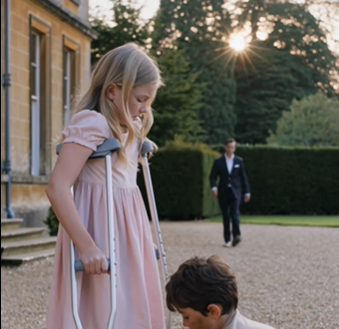
The little girl stood motionless on her crutches, staring at the bottle.
The father stared at the boy.
And all the warm golden sunlight on the estate suddenly felt cold.
“What did you just say?” he asked.
The boy tightened his fingers around the glass bottle.
“My mother cleaned here at night,” he said. “She said the pretty lady with the soft voice always emptied one bottle before the girl’s baths and hid the rest where no one would look.”
The father’s mouth went dry.
Because there had been a housekeeper.
A quiet widow who worked evening shifts and vanished two years ago after telling the kitchen staff she had “seen too much to sleep.”
His wife said she stole jewelry.
Security said she ran.
The police never cared enough to check twice.
The boy’s voice shook now, but he kept going.
“She took one bottle home because she thought it was poison. She wanted to show someone. But before she could…”
He looked down.
“They found her by the river.”
The father went pale.
The little girl’s crutches slipped slightly on the gravel.
“Daddy?” she whispered.
He looked at her and saw, all at once, every moment he had failed her:
the baths,
the pills,
the nights his wife insisted the child was “getting worse,”
the way his daughter cried every time the treatment room door closed,
the way she flinched whenever the woman touched her ankles.
And worst of all, the way he had explained all of it away because trusting a polished lie felt easier than facing an ugly truth.
He knelt beside the tub.
“Sweetheart,” he said, voice breaking, “did she ever hurt you?”
The little girl’s face crumpled.
“She said if I told you,” she whispered, “you’d send me away because broken girls are expensive.”
The father closed his eyes.
That sentence hit like a knife.
The boy slowly handed him the bottle.
“There’s more,” he said.
“What more?”
The boy hesitated.
Then reached into his pocket and pulled out a folded paper so worn it looked like it had been opened a hundred times.
“My mother left this for me if anything happened to her.”
The father unfolded it with trembling hands.
Inside was a short note in uneven handwriting:
If the child’s father ever learns the truth, tell him the medicine was never for pain. It was to keep her legs weak until the marriage papers were signed.
The father’s whole body went still.
Marriage papers.
Not treatment.
Not caregiving.
Not love.
His wife had not stayed because she was loyal.
She had stayed because she was waiting.
Waiting for inheritance papers tied to the child’s medical guardianship.
Waiting for signatures.
Waiting for legal control over the estate if the father died before the girl recovered.
The little girl began crying quietly now.
The father stood up too fast, his expression no longer shocked.
Deadly.
Then, from the mansion doorway, a calm female voice cut through the garden:
“What exactly are you reading?”
All three turned.
His wife stood on the stone steps in a white dress, elegant as ever, watching them with one hand resting lightly on the railing.
Her smile was small.
Controlled.
And when her eyes dropped to the bottle in his hand, that smile disappeared.
Because for the first time, she understood something had survived that was never supposed to.