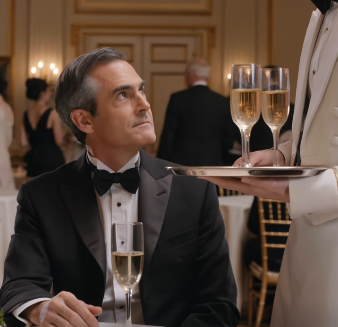
He stared at the napkin as though time had split open in his hands.
It was real.
The stain in the corner.
The rushed slant of his writing.
The line he scribbled one rainy night while the woman he loved laughed and said their child would probably hate piano lessons.
But the child had never been born.
At least that was the lie he had lived with for twenty-two years.
The waiter stood beside the piano in complete silence, letting the truth work its way through the room like poison.
The guests looked from one face to the other, sensing something far bigger than a musical performance had just happened.
“Where did you get this?” the man asked, his voice cracking.
“My mother kept it,” the waiter replied.
The man gripped the edge of the piano.
“Your mother’s name.”
The young man swallowed once.
“Elena.”
The name hit him like a blow to the chest.
He had searched for Elena after she vanished, until his powerful family convinced him she had betrayed him, sold his letters, and left the country with another man.
The waiter’s jaw tightened.
“She never left you,” he said quietly. “She was paid to disappear.”
The room went cold.
The man looked shattered.
The waiter reached into his pocket again and placed one more item on the piano.
A hospital bracelet.
Tiny. Faded. Infant-sized.
The older man stared at it, trembling.
“My mother gave me that too,” the waiter said. “She told me if I ever met the man who wrote the song, I should ask him why he never came.”
The man’s eyes filled instantly.
“I did come,” he whispered. “I came every day.”
The waiter froze.
Because pain had taught him to expect abandonment, not grief.
Then a voice broke through the silence from the back of the ballroom.
“You came,” it said, trembling, “but not past me.”
Everyone turned.
An elegant older woman in black gloves stood near the ballroom doors, pale as death.
The man in the tuxedo went white.
Because it was his mother.
And she was staring at the hospital bracelet like she had just seen the proof of the life she stole.