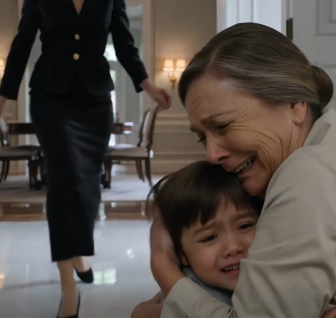
The guests said nothing.
No one even bent down to pick up the broken plate.
The child looked between them, confused and crying, still wrapped around the nanny’s neck.
“What’s wrong?” she whispered.
The nanny closed her eyes for one second, like she had waited years for this moment and still prayed it would never come.
Then she opened them and said the truth out loud.
“Your mother didn’t die without leaving you.”
The little girl’s fingers tightened.
The rich woman shook her head violently.
“Stop,” she whispered. “Stop right now.”
But the nanny was crying too hard to stay silent anymore.
“Your sister gave birth in this house,” she said, looking at the rich woman. “She was weak. She knew she might not survive. She put that photo in the pendant and begged me… begged me… that if anything happened, her daughter would know the truth one day.”
The rich woman’s legs nearly gave out.
Because it was true.
Her sister had died that same night.
And in the hours after the funeral, while the house was drowning in grief, she had made a decision no one was ever supposed to question.
She kept the baby.
Raised her as her own.
Buried the truth with the dead.
At first she told herself it was love.
Then protection.
Then necessity.
But over the years, love turned into possession.
And possession turned into fear.
That was why she wanted the nanny gone.
Because the older woman had started telling the little girl bedtime stories about a mother with the same eyes… the same laugh… the same lullaby.
The child slowly pulled back and looked at the rich woman.
“You’re… not my mommy?”
The question shattered the room.
The rich woman burst into tears.
“I am the one who raised you,” she said, voice breaking. “I loved you. I still love you.”
The little girl turned to the nanny, trembling.
“And my real mommy?”
The nanny kissed her forehead and sobbed.
“She loved you before you even opened your eyes.”
The child looked down at the open pendant, at the faded woman holding the baby, and something in her face changed — the kind of pain no child should ever have to understand.
Then she asked the question no one in that room was ready for.
“Why didn’t you tell me… Nana?”
The nanny broke completely.
“Because she made me promise to wait until I knew they couldn’t take me away from you.”
The rich woman covered her mouth and sank into a chair, destroyed by the one thing money could never control forever.
Truth.
And in the middle of the luxury dining room, with everyone watching in silence, the little girl picked up the pendant, stared at her dead mother’s picture, then climbed back into the nanny’s arms and whispered:
“So I still had a grandma…
all this time.”