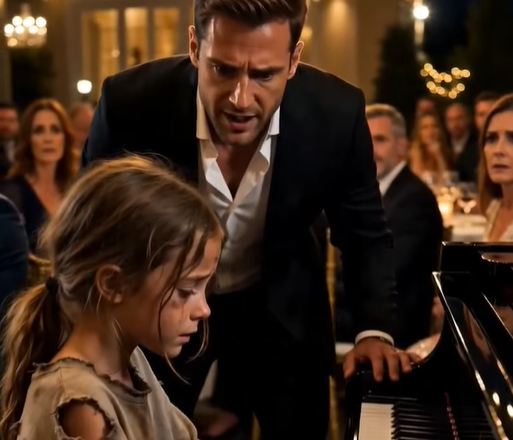
For one long second, nobody on the terrace moved.
Not the diners.
Not the servers.
Not even the man in blue who had mocked her.
The final piano notes still hung in the warm night air.
And the man in black stood there like someone had just torn open the part of his life he buried deepest.
Years earlier, before the tailored suits and the elegant restaurants, there had been a woman.
She played piano in a small hotel lounge by the coast.
He fell in love with her there — not because she was glamorous, but because she could make a room go quiet with one hand and heal it with the other.
Then she got pregnant.
And everything changed.
His family called her a mistake.
His business partners called her a liability.
He promised he would fix it, promised he would come back, promised he would protect them both.
Then he vanished into the life expected of him.
Not because he stopped loving her.
Because he was weak enough to let wealth choose for him.
He searched later.
Too late.
By then, she was gone.
Or so he was told.
Now her daughter was sitting at a grand piano in torn clothes, carrying the one melody only that woman could have taught.
The girl slid off the bench slowly.
The whole terrace watched.
Her face was tear-streaked, but her voice stayed steady.
“She played it when I was hungry,” she whispered.
“She played it when it rained through the roof.”
A pause.
“She played it when she was dying.”
That broke something visible in his face.
The man took one shaky step closer.
“What was her name?” he asked, though some part of him already knew.
The girl said it.
And he closed his eyes for one second because it was her.
It had always been her.
The man in blue looked away now, ashamed.
Because the child he mocked for bread was not just some beggar with talent.
She was the daughter of the woman this man once loved enough to ruin — and not enough to save.
The girl reached into her torn sleeve and pulled out a folded page, old and worn at the edges.
“My mom said if I ever found you,” she said softly, “I should give you this after the song.”
He took it with trembling fingers.
Inside, in a woman’s fading handwriting, were the words:
She remembers the lullaby.
If she can still play it, then poverty didn’t take everything from us.
If you hear it and still walk away, then you never loved either of us at all.
The terrace felt smaller after that.
No chandeliers.
No candles.
No polished glasses could soften it.
Because suddenly everyone understood:
this was not a performance.
It was judgment.
And the little girl did not come for bread.
She came to place her mother’s last truth in front of the man who abandoned them both — and make him decide, in public, who he really was.