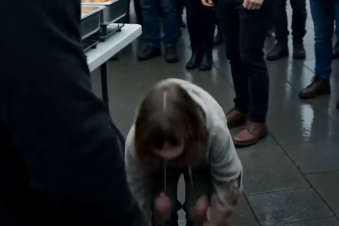
For one long second, the whole city square forgot how to breathe.
Not the volunteers.
Not the people in line.
Not even the camera phones still pointed in his direction.
Because suddenly the famous charity man no longer looked generous.
He looked cornered.
He stared at the photograph in his hand as if the younger version of himself had stepped out of it to accuse him in public.
Years earlier, before the foundation, before the speeches, before the soft voice he used for interviews and ribbon cuttings, he had spent one winter volunteering at a shelter. There he met a pregnant woman who owned nothing but a stubborn sense of dignity and the habit of pretending she wasn’t colder than she was.
He told her he would help.
Told her he would come back.
Told her she wouldn’t be alone.
Then opportunity arrived.
A wealthy donor took interest in him.
A political circle opened.
A career in visible kindness became possible.
And the homeless woman became an inconvenience he convinced himself he would “fix later.”
Later never came.
The little girl standing in front of him was what later looked like.
Thin. Wet. Brave because she had no one left to be scared for her.
His voice came out rough.
“Where is your mother?”
The answer was small.
“She died last week.”
That sentence shattered the last layer of performance.
Because this was not a setup.
Not a rumor.
Not a bitter woman seeking revenge from afar.
This was a daughter obeying the final instruction of the mother he abandoned.
The girl looked down at the note, then back at him.
“She said you’d know her eyes in mine.”
And there it was — not just resemblance, but accusation woven into blood.
The line behind her had gone still.
The volunteer stared at the ground.
Even the people filming seemed ashamed now.
The charity man could feel every camera turned toward him, but for the first time in years, he didn’t seem to care about the image.
Only the truth.
He unfolded the note completely.
On the back, written in weaker handwriting, were the final words:
If she comes to you hungry, don’t feed her for the cameras. Feed her because she is yours.
That was when his face finally broke.
Not theatrically.
Not loudly.
Just enough for the whole square to understand this was real.
The little girl clutched the empty bowl tighter and asked the question that turned the cold morning into a courtroom:
“Are strangers still easier to love?”
No speech could save him after that.
Because everyone there suddenly understood what the cameras had accidentally caught:
a man famous for feeding the city
had left his own child waiting in the same line.
And the child did not come for publicity, pity, or revenge.
She came because a dying mother wanted one answer before the world decided what kind of man he was.