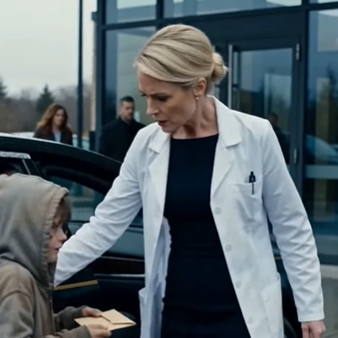
The letter almost fell to the wet pavement, but she caught it at the last second.
Too late to protect herself from what it said.
For one long second, the hospital entrance disappeared.
Not the traffic.
Not the footsteps.
Not the cold.
Only the child.
And the handwriting on the page.
Years earlier, before the promotions, the private office, the expensive car, and the perfectly controlled reputation, she had been a junior resident on a maternity floor when a young poor woman gave birth alone after a complicated emergency.
No husband.
No family.
No money.
Just fear.
The baby was healthy.
The mother was not.
There were forms.
Social workers.
A temporary placement.
A promise that the mother would get him back when she stabilized.
But “temporary” became permanent the moment the paperwork passed through the wrong hands.
Her hands.
Not because she wanted the baby.
Because she signed what she was told to sign.
Because a senior physician said the child would “have a better chance.”
Because the hospital board wanted quiet outcomes, not difficult mothers.
Because ambition makes cowardice sound reasonable when spoken in professional language.
And then the file disappeared.
The mother disappeared too.
At least that was what she told herself.
Until now.
The boy was still standing in front of her in wet shoes and worn clothes, carrying the final proof that his mother had never disappeared.
She had survived long enough to remember exactly who took her son out of her arms.
The woman looked down at the letter again.
Her name at the top.
Below it, in shaky writing:
You said it was temporary.
You said he would come back to me.
If you are reading this, then I ran out of time before I could make you keep your word.
Her breathing changed.
The boy watched her carefully.
Not like a child begging.
Like a child trying to understand whether the person in front of him was cruel… or just too late.
Her voice came out rough now.
“Did she tell you my name?”
He nodded.
“She said you cried after you signed.”
That hit harder than accusation.
Because it was true.
She had cried in the supply closet afterward.
Then gone back to work.
Then built a life.
Then buried the memory beneath years of white coats and clean decisions.
But the buried things had found their way to her anyway.
In the form of a boy at a hospital curb.
She crouched slowly to his height.
Not because she deserved forgiveness.
Because standing over him felt obscene now.
“What was her name?” she asked.
He told her.
And she shut her eyes for one second.
She remembered.
The frightened young mother with cracked lips, fever, and one hand always reaching for the bassinet.
The woman she failed.
The boy’s voice shook.
“She said if you looked scared… then you remembered me.”
That broke whatever was left of her professional calm.
Because suddenly this wasn’t a random confrontation in public.
It was judgment.
And a final chance.
The hospital doors kept opening and closing behind them.
But out on that wet curb, under the gray afternoon sky, nothing mattered except the truth:
the homeless boy she was told had been “placed” safely
had come back
to the one person
who knew exactly how he was lost.