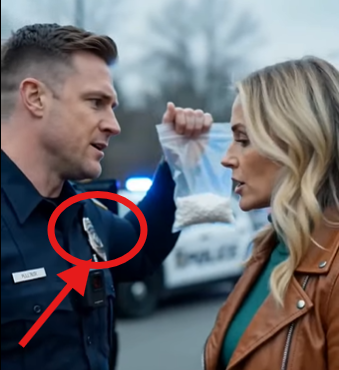
The second SUV rolled to a stop without urgency.
That was what made it worse.
No siren.
No shouting.
No chaos.
Just certainty.
The officer looked over his shoulder once, saw who was stepping out, and knew immediately that nothing he said next would save him.
Two plainclothes investigators.
One captain.
And the woman in front of him still standing calm enough to make his panic look childish.
The plastic bag finally hit the ground.
No one moved to pick it up.
Because now it wasn’t evidence.
It was evidence of him.
Years earlier, he had learned the trick from older cops who called it “street correction.” Plant on the right people, file the right report, keep the pressure where the department wants it. It started small — a knife, a loose bag, an “anonymous tip” that always seemed to target someone too poor, too alone, or too easy to bury in paperwork.
Then he got good at it.
Too good.
Internal Affairs had been hearing whispers for months.
No clean witness.
No clean footage.
No officer dumb enough to do it under the wrong camera.
Until today.
The woman in the leather jacket had not been a random driver.
She had chosen the route.
Chosen the car.
Chosen the stop.
And waited to see which officer would take the bait.
He did.
The officer tried one last breath of arrogance.
“I didn’t know who you were.”
The woman’s expression didn’t move.
“That’s the point.”
That landed harder than any threat.
Because suddenly he understood this was not a lucky catch.
It was a test.
And he had failed it on instinct.
The captain approached, looked at the bag on the ground, then at the blinking bodycam on the officer’s chest.
“Turn it off,” the officer said weakly, almost to no one.
The woman shook her head.
“No,” she said.
“Now it stays on.”
That was the cruel genius of it.
Everything he had once used to manufacture truth was now trapping him in the real one.
The bodycam.
The timing.
His own words.
His own hand.
The officer’s shoulders finally dropped.
Not in surrender exactly.
In recognition.
Because he could already see the report writing itself without him:
recovered contraband introduced by arresting officer,
footage preserved,
chain of custody compromised,
investigation opened.
His career was already becoming past tense.
Then the woman stepped close enough that only he could hear her clearly over the soft radio crackle and fading traffic noise.
“You know what your problem was?”
He didn’t answer.
She did anyway.
“You got used to people being scared before they were believed.”
That finished him.
Because that was true too.
And now, for the first time in a long time, the person he tried to frame was not afraid, not powerless, and not alone.
The captain bent, picked up the bag with gloves, and nodded to the investigators.
The officer was turned around, wrists being taken, while the bodycam still blinked red against his chest.
He looked once more at the woman.
Not with hatred.
With disbelief.
Because the whole stop had lasted less than two minutes.
And in less than two minutes, he had gone from hunter to headline.