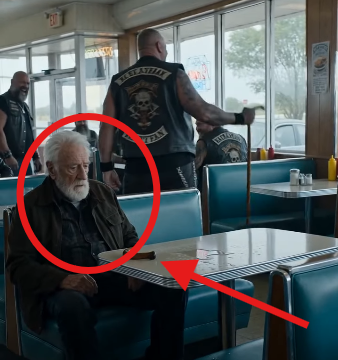
For one long second, nobody in the diner moved.
Not the bikers.
Not the waitress.
Not even the cook peering out from the kitchen.
Because suddenly the old man at the booth was no longer just an old man with a cane.
And the cane on the floor was no longer a joke.
The black SUVs outside had changed everything.
Doors opened in near-perfect rhythm.
Men in dark suits stepped out fast.
Not local cops.
Not bodyguards for hire.
Professional.
Trained.
The kind of men who moved like they were already late to protecting someone important.
The biker nearest the window took a half-step back.
The big one in the aisle tried to recover first.
He laughed once, but it sounded dry now.
“Who the hell are you?”
The old man still didn’t raise his voice.
He looked at the cane lying between them, then at the biker, then down at the water soaking into the cuff of his shirt.
Only then did he answer:
“Someone your father used to stand for.”
That line hit strangely.
Not because the biker understood it.
Because he almost did.
The security detail entered the diner fast, scanning the room. One of them moved for the cane immediately. Another stopped beside the booth.
“Sir,” he said, low and controlled. “Are you hurt?”
The old man shook his head once.
“No.”
Then his eyes returned to the biker.
Years earlier, before age bent his back and whitened his beard, he had been a state judge. The kind men feared because he couldn’t be bought. The kind that sent violent people away when everyone else was too scared to testify. He had sentenced gang leaders, crooked businessmen, and one particular biker boss whose son now stood in the diner holding onto borrowed swagger and fading nerve.
The old man had recognized the face almost immediately.
Same jaw.
Same eyes.
Same arrogance.
Only younger.
Dumber.
The biker’s voice dropped.
“You know my father?”
The judge didn’t blink.
“I buried his power in paperwork twenty years ago.”
Now the silence in the diner became something else.
Not suspense.
Judgment.
One of the other bikers looked toward the door like he was already calculating distance. Another slowly raised both hands without being told to.
Because now they understood the worst part:
this was not random.
They had humiliated a man whose name still carried weight in places their leather and noise could never reach.
The big biker looked down at the cane.
Then at the shattered glass.
Then back at the judge.
And for the first time, his voice sounded young.
“What do you want?”
The old man answered with terrible calm:
“For you to pick it up.”
That was the sentence that broke the room.
Not because it was dramatic.
Because it wasn’t.
Because after all the engines, the threats, the public humiliation, the revenge wasn’t violence.
It was dignity returned in the simplest possible form.
The biker stared at him.
At the men in suits.
At the eyes in the diner watching.
At the floor.
Then he bent.
Slowly.
Picked up the cane with both hands.
And held it out.
The judge accepted it without thanks, rose with effort, and stood in front of him at last.
Small. Old. Steady.
Then he said the line that finished the whole thing:
“Your father taught you how to scare a room.
I taught him what happens after.”
And suddenly the diner wasn’t a place where an old man had been mocked.
It was a courtroom with coffee cups.
And everyone knew who had lost.