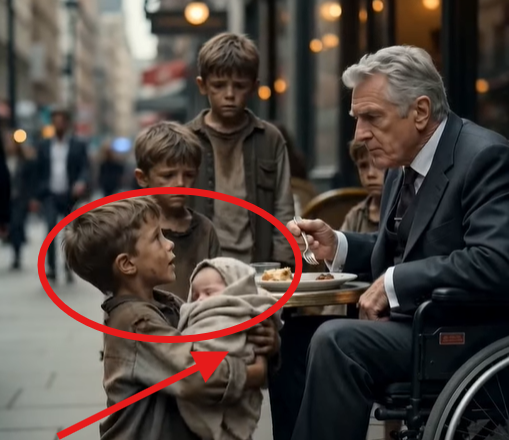
For one long second, the whole sidewalk disappeared.
Not the traffic.
Not the café noise.
Not the people staring now from behind glass and coffee cups.
Only the baby.
And the tiny silver half-moon at her throat.
The old man stared at it like his heart had stopped somewhere between one beat and the next.
Because that charm was not sold in stores.
He had commissioned it himself years ago — one piece of a pair made the week his daughter was born. She wore hers until the day fever took her before her first birthday. When they buried her, the charm went with her.
At least that was what he had been told.
Now the same moon shape was hanging around the neck of a baby held by a starving child on a city sidewalk.
His voice came out cracked.
“Where did you get that?”
The kneeling boy looked down at the baby, then back up.
“Our mom tied it on her.”
A pause.
“Before she died.”
That landed harder than the miracle in his leg.
Because now this wasn’t some strange healing trick.
It was family.
The old man looked at the baby again — really looked — and saw it in the face, not fully formed yet but there all the same: the same mouth his daughter had as an infant, the same brow, the same small stubborn stillness.
His hand moved shakily toward his own chest, where under his shirt, hidden for years, he still wore the other half of the moon.
The boy’s lips trembled.
“She said if the baby made your foot move,” he whispered, “then you were the one she wrote about.”
The old man’s breath caught.
“What did she write?”
The boy reached into his torn pocket and pulled out a folded page, soft at the edges from being opened too many times. He set it on the table beside the untouched meal.
The old man unfolded it with trembling fingers.
It was his daughter’s handwriting.
Older now.
Uneven.
Alive far longer than he had ever been allowed to believe.
Years earlier, after she ran away with a man he called beneath her, he cut her off in rage. Months later he was told she and the baby had both died in a roadside fire. He never saw a body. He never asked enough questions. Pride buried what grief should have chased.
Now, in her letter, she had written the truth:
she survived,
the man abandoned her,
the baby lived,
and she had stayed away because she believed her father would rather lose blood than lose control.
But sickness changed everything.
In the last lines she wrote:
If she touches you and your body remembers us, don’t let my children go hungry the way your anger left me hungry.
That broke him.
Not loudly.
Not publicly.
But enough.
Enough for the café, the children, and the whole hard city around them to feel the moment change.
The old man looked at the plate in front of him, then at the children standing there trying not to hope too much.
Because that was the ugliest part:
they hadn’t come for magic.
They had come because they were hungry, alone, and carrying the only proof left that he belonged to them.
He pushed the plate toward the boy first.
Then reached for the baby with both hands.
And for the first time in years, the man in the wheelchair understood that the movement in his leg was not the true miracle.
The real miracle was that blood had found him
before pride buried him too.