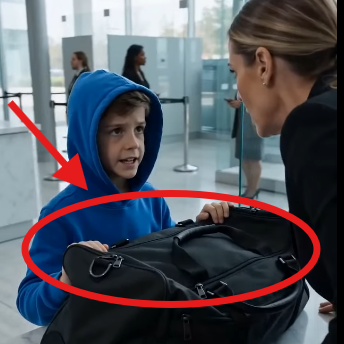
For one long second, the whole café lost its softness.
Not the sunlight.
Not the trees.
Not the clinking glasses.
Just the illusion.
Because suddenly this wasn’t an awkward interruption by a dirty child.
It was a door opening on something buried.
The woman in black took one step off the café stones and onto the garden path, her eyes locked on the woman in gray like she was watching a ghost decide whether to flee.
The boy clutched the jeweled clip in both hands and hurried after her.
“She’s sick,” he said.
“Mom sent me because she can’t run anymore.”
That sentence hit like a blade.
Because now it wasn’t just about the sister who vanished.
It was about time running out.
Years earlier, when the woman in black’s younger sister got pregnant by the wrong man, the family panicked. There was scandal to avoid, inheritance to protect, names to keep clean. The woman in gray — then a trusted assistant to the family — took control of everything. She was supposed to move the sister somewhere quiet until the mess could be handled.
Instead, she disappeared with her.
The official story became simple and cruel: the sister ran away, cut contact, refused to return, chose her own life.
The family believed it because believing it was easier than asking the kind of questions money hates.
But the truth was uglier.
The woman in gray had hidden her.
Not out of kindness.
Out of leverage.
The pregnant sister became a secret she could use whenever the family needed to be reminded how much she knew.
And when the baby was born, the secret became harder to kill than to control.
That baby was the boy standing there now.
The woman in black looked from him to the hair clip in his hands, then back to the woman in gray, who had stopped walking but hadn’t turned around fully yet.
The boy’s voice got smaller.
“She said to show you the clip first.”
A pause.
“She said you’d remember the night you put it in her hair.”
And she did remember.
A summer party.
A mirror.
Two sisters laughing.
A promise whispered as a joke that they would always find each other by something beautiful.
The woman in black’s face changed from shock to something harder.
Not grief.
Decision.
“Where is she?” she asked again.
This time, the question was for the woman in gray.
The woman in gray finally turned.
Her face had that terrible stillness guilty people wear when they know the lie has ended and are just trying to choose which part of the truth will hurt them least.
“She’s in the car,” she said.
That line froze everyone.
Because the sister had been closer than memory.
Closer than mourning.
Closer than all the years that had been stolen.
Parked just beyond the hedge, in a dark sedan half-shadowed by trees, was the woman everyone thought had abandoned her family. Thinner now. Paler. One hand weakly pressed to the window. Alive, but barely.
The woman in black covered her mouth.
Not because she doubted it.
Because she didn’t.
And suddenly the dirty little boy at the café wasn’t some stranger carrying a trinket and a story.
He was her sister’s son.
The child born inside a disappearance.
The one who had crossed into her polished life carrying the exact proof needed to break it open.
The boy looked up at her and asked the smallest, most devastating question of all:
“Are you still her sister?”
That was the moment the whole lie collapsed.
Not because of the woman in gray.
Not because of the clip.
Not even because of the car waiting behind the hedge.
Because blood had finally come back asking whether love had survived the years it was denied.