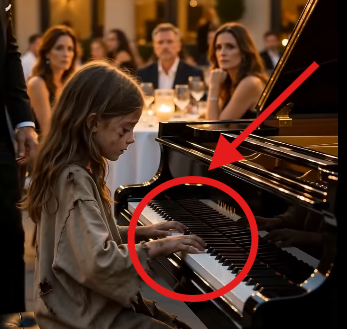
For a long second, the man in black could not move.
He just stared at the little girl, at the necklace resting against her torn shirt, at the eyes that looked too much like someone he had spent years trying to forget and failing.
“What is your mother’s name?” he asked.
The girl swallowed hard.
“Elena.”
The world tilted.
A woman at a nearby table covered her mouth. The mocking man looked down at his plate, suddenly unable to meet anyone’s eyes. Even the waitstaff stood frozen.
The man in black sank slowly to his knees in front of the piano bench.
His voice came out almost broken.
“Elena is… your mother?”
The girl nodded.
“She died two weeks ago.”
He shut his eyes.
The words hit harder than anything in his life ever had.
“When she got sick,” the girl whispered, “she told me if I ever found the restaurant with the gold lights and the piano, I should play your song.” Her fingers pressed softly against the keys without making sound. “She said you would know.”
He looked at her like he was seeing both the past and the punishment for it at the same time.
“I didn’t know,” he said. “I swear to you… I didn’t know.”
The girl’s eyes filled again, but her voice stayed steady.
“She waited for you.”
His chest tightened so hard he thought it might stop his heart.
Years earlier, he had loved Elena with the kind of love that changes a person. But his wealthy father had hated her — said she was poor, unsuitable, dangerous to the family name. Then one day his father told him Elena had taken money and disappeared with another man.
He had believed it.
He had been weak enough to believe it.
And because of that, he had never gone after her.
Never searched hard enough.
Never learned the truth.
The girl slowly pulled something from her pocket and held it out across the piano.
It was an old folded letter, worn at the edges.
“She told me to give you this if you looked sorry.”
With shaking hands, he opened it.
Inside, in Elena’s handwriting, were just a few lines:
I never left because I stopped loving you.
Your father paid me to disappear and told me you chose your future.
When I found out I was pregnant, I wanted to come back.
But then I saw your engagement in the papers.
So I raised her with your music.
If she ever reaches you, please do one thing better than we did: stay.
His vision blurred.
He lowered the letter and looked at the little girl.
“What’s your name?”
“Lia.”
He repeated it softly, like it hurt.
“Lia.”
She wiped her face with her sleeve.
“I came here three nights in a row,” she said. “But I was too scared.”
He looked at her hands, still resting on the piano keys. Elena’s hands. Elena’s daughter.
Then he noticed how thin she was. How tired. How alone.
And something inside him broke wide open.
He reached for her slowly, giving her time to pull away.
She didn’t.
He wrapped his arms around her and held her as carefully as if the whole world depended on it.
The elegant diners looked away, ashamed to have watched a child be humiliated before realizing she was someone’s lost blood, someone’s living grief.
The mocking man stood up, but no one cared about him anymore.
Lia spoke into the man’s shoulder, her voice tiny.
“Mom said if you cried, you were probably telling the truth.”
He laughed once through tears.
Then cried harder.
“I should have found you,” he whispered.
She didn’t answer for a second.
Then she said the one thing that shattered him completely:
“You can still take me home.”
And for the first time in many years, the man in black stopped being a stranger inside his own life.
He stood up with Lia in his arms, Elena’s letter in one hand, and the entire terrace watching in stunned silence.
The piano remained behind them.
But the melody did not.
It followed them into the night like a promise finally kept.