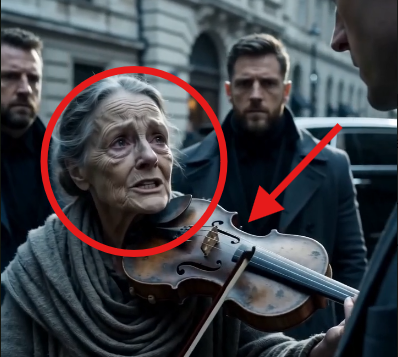
No one moved.
Not Lucien.
Not the bodyguards.
Not even his father.
The city was still all around them, but the moment had become its own sealed room.
Lucien looked from the woman to his father and understood the truth before anyone admitted it:
his father knew exactly who she was.
“Get in the car,” his father said.
His voice was calm, but too fast.
Too practiced.
Too late.
Lucien didn’t move.
The woman held her violin against her chest like the last piece of her own body.
“What is she talking about?” Lucien asked.
His father’s gaze hardened.
“She’s sick. Delusional. I told security years ago never to let her near you.”
The woman laughed once, and it came out like pain.
“Delusional?” she whispered. “I still know the scar on his knee from when he fell chasing pigeons. I still know he hated milk unless I warmed it first. I still know he cried if I stopped the lullaby before the last note.”
Lucien’s face changed.
Because every word was true.
Not things anyone could learn from society pages. Not stories a stranger could invent. Small childhood truths. Private ones. The kind of details that come from love, not research.
His father saw it happen.
Saw belief crack through him.
So he tried to crush it quickly.
“She abandoned you,” he snapped. “I protected you.”
“No,” the woman said. “You erased me.”
Lucien turned fully toward his father now.
“Answer me.”
For the first time in years, his father hesitated.
That hesitation was everything.
The woman stepped forward despite the pain in her body.
“I was twenty-three. Poor. A violin teacher. I loved your father’s son, and he loved me. When I got pregnant, he promised he would help us.” Her eyes fixed on the old man. “Instead, he paid people to tell the court I was unstable. He took my baby before I could even stand.”
Lucien’s throat tightened so hard it hurt.
His father finally exploded.
“I gave you a life!” he shouted at Lucien. “A future! Power! Respect! Everything she never could!”
Lucien stared at him.
And very quietly asked, “At the price of my mother?”
The old man said nothing.
Which was answer enough.
The violin slipped a little in the woman’s hands. Lucien caught it before it hit the stones.
Their fingers touched for the briefest second.
And she looked at him the same way she must have looked at him when he was small and sick and frightened of the dark.
His whole face collapsed.
“Why didn’t you come sooner?” he whispered.
Tears filled her eyes.
“I did.”
One sentence.
Soft.
Destroying.
“I came to your school once. They turned me away. I came to your house twice. They said the young master was traveling. I waited outside a concert hall in the rain just to see you walk past.” Her mouth trembled. “Then I understood. He had built a world around you that had no door for me.”
Lucien closed his eyes.
He had lived inside that world.
Defended it.
Inherited it.
Never knowing it had been built over a grave that was never filled.
When he opened his eyes again, they were wet.
His father took one step forward.
“Lucien, listen to me. She will say anything now. She needs money.”
That was the final mistake.
The woman slowly opened the old violin case.
Inside, beneath the torn velvet lining, was a stack of letters tied in ribbon.
She held them out.
“For every birthday I missed,” she said.
Lucien took them with shaking hands.
The first envelope had childish handwriting on the outside:
For my son, when he turns 7
The second:
For my son, when he turns 10
Then 12.
Then 15.
Then 18.
A life of unsent love.
A motherhood forced to write into emptiness.
Lucien looked at his father with a calm that frightened everyone more than rage would have.
“You let her write to a dead address.”
His father’s expression broke at last.
Not into remorse.
Into defeat.
“I did what was necessary,” he said.
The woman whispered, “No. You did what was cruel.”
Lucien stood between them, the letters in one hand, the violin in the other, and felt his entire life rearrange itself in one terrible minute.
Then he turned to the bodyguards.
“Take his keys.”
The old man stared at him.
“Lucien.”
He didn’t answer.
He stepped closer to the woman instead.
Up close, he could see how tired she was. How thin. How much pain she was hiding simply to remain standing in front of him long enough to be believed.
“What’s your name?” he asked, though now he already knew it mattered more than any title he had ever carried.
“Eva,” she whispered. “Eva Morel.”
He nodded once.
Then his voice broke on the next word.
“Mom.”
That did it.
The violin slipped from her hand and Lucien caught her before she fell with it.
She clutched his coat, sobbing into his chest like all the missing years had suddenly found each other. He held her with both arms, not caring about the street, the onlookers, or the power he had just turned against its source.
Across the curb, his father stood alone beside the black car, smaller than he had ever looked in Lucien’s life.
Lucien pulled back just enough to look at Eva’s face.
“You said you’re dying.”
She gave the faintest nod.
“The doctor said there isn’t much time.”
Lucien wiped at his face roughly, then took out his phone.
“There is now,” he said.
He called his private medical director and spoke without hesitation.
“This is Lucien Armand. Prepare the clinic. Full team. Immediate admission.” His gaze never left her. “My mother is coming home with me.”
Then he ended the call, took her violin in one hand and her arm in the other, and led her away from the curb where she had been forced to play for strangers.
No more street.
No more distance.
No more erased song.
Behind them, the city kept moving.
But Lucien didn’t look back.
Because for the first time in his life, he knew exactly where he was going—
toward the only voice that had ever truly been his first home.