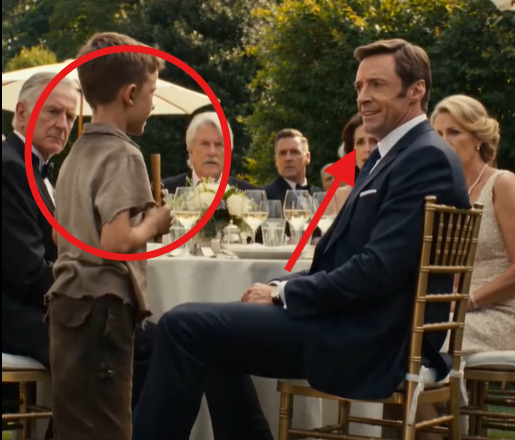
For a second, Victor couldn’t move.
Not because of the bill.
Because of the name.
Elena Hale.
He hadn’t heard Elena’s name spoken aloud in years. Not since the day his father tore her photo in half and told him she had “disappeared for good.” Victor had been young, weak, and too obedient. He had searched for her once, maybe twice — but when no one would tell him the truth, he let wealth, pressure, and time silence him.
Now her name was lying on a white tablecloth in front of half the city’s elite.
And so was her son.
Victor picked up the paper with trembling fingers.
“What hospital is she in?” he asked.
The boy’s face tightened. He had expected denial. Maybe anger. Maybe guards dragging him away.
He had not expected fear.
“She’s not in the hospital yet,” the boy said quietly. “They won’t do the surgery until we pay.”
That landed even harder.
The guests were no longer pretending not to listen. Every table had gone completely still.
Victor looked at the boy again — really looked at him — and saw what pride and cruelty had hidden from him at first: the hunger in his cheeks, the exhaustion in his eyes, the way he held himself like someone who had been trying to be brave for much too long.
“What’s your name?” Victor asked.
The boy hesitated.
“Daniel.”
Victor shut his eyes for a moment.
That had been the name Elena once chose in a letter he never got to answer. If they ever had a son, she had written, she wanted to name him after Victor’s late brother.
His throat tightened so hard it hurt.
“How long has your mother been sick?”
Daniel’s voice dropped.
“A long time. She got worse last week.” He swallowed. “She told me not to come here. She said you owe us nothing.” A tear slipped down his cheek. “But she was crying when she said it.”
Victor looked like he’d been struck.
He folded the hospital paper once, carefully, like it was something sacred, then set it in his breast pocket. No one at the table dared speak.
Then he said, low and shaking, “Take me to her.”
A woman nearby whispered, “Victor…”
He turned his head just enough for her to fall silent.
This was no longer a luncheon.
This was judgment.
Daniel didn’t move at first.
He studied Victor’s face like he was trying to decide whether a man like this could be trusted at all.
Then he asked the question that made the entire table hold its breath:
“If she dies before we get there… will you leave again?”
Victor’s face broke.
Not with anger.
With shame.
And for the first time in years, the powerful man everyone feared looked like a man who hated himself.
“No,” he said. “Not again. Never again.”
Daniel searched his eyes for a lie.
He found none.
So he slowly put the little flute under his arm, wiped his face with the back of his hand, and nodded once.
Victor turned to the stunned guests around him.
“Lunch is over.”
Then he took off his suit jacket, draped it over the boy’s shoulders, and walked with him out through the garden — not ahead of him, not behind him, but beside him.
As they reached the gate, Daniel looked up and asked softly, “Why did the song scare you?”
Victor’s voice almost failed.
“Because your mother used to play it,” he said. “When she was happy.”
Daniel looked down at the flute.
“She taught it to me,” he whispered.
Victor stopped walking for half a second, overwhelmed by everything he had already lost.
Then he placed one shaking hand on the boy’s shoulder and kept moving.
Because for the first time in many years, he understood something clearly:
The child hadn’t come for charity.
He had come to drag the truth into the light.
And Victor was finally going to face it.