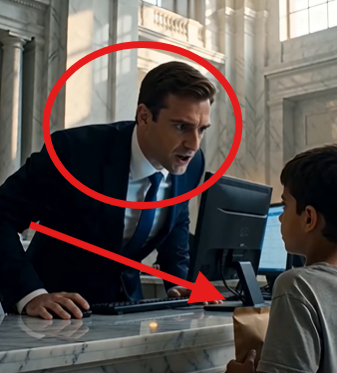
The teller’s voice caught in his throat.
The police officer stepped closer.
“What account?” he asked.
The teller blinked hard, still staring at the screen, then finally said the words no one in the bank was ready to hear:
“This account holds twelve million dollars.”
A gasp moved through the room.
The little boy just stood there, confused.
He didn’t react like a child who had heard a fortune.
He reacted like a child who didn’t fully understand numbers that big.
He only asked, in the same small voice:
“Then… can I take some out for my grandma?”
That question broke the silence harder than the amount.
The teller looked at him.
“For your grandmother?”
The boy’s fingers tightened around the brown envelope.
His chin trembled.
“She died this morning,” he whispered. “Before she died, she told me to come here if the landlord tried to throw me out.”
Now even the officer’s expression changed.
The boy slowly opened the brown envelope and pulled out a folded paper, soft at the corners from being held too tightly.
It was a handwritten letter.
“My grandmother said to give this to the bank manager,” he said.
The teller took it with shaking hands.
Before he could open it, a voice came from behind them.
“Let me see that.”
The bank manager had arrived.
An older man.
Perfect suit.
Silver hair.
The kind of man everyone listened to instantly.
He unfolded the paper.
His eyes moved across the lines.
Then his face went still.
“What does it say?” the officer asked.
The manager looked up slowly.
His voice came out low and stunned.
“It says the boy is the sole heir to the estate of Eleanor Vale.”
A murmur ran through the bank.
Even the teller stepped back.
Everyone in that city knew the name Eleanor Vale.
She had been one of the bank’s biggest investors.
A woman with old money, old property, and more influence than most politicians.
And the little boy standing barefoot in all that marble and power…
was her heir.
But the manager wasn’t done reading.
His eyes dropped back to the page, and then something in his face changed again.
More personal.
More shaken.
He swallowed.
“There’s more.”
The boy looked up.
The manager read the final line out loud:
“Tell my grandson that I kept him hidden because my own family would destroy him if they knew he existed. If he is standing in your bank alone, then I am already gone.”
The room fell dead silent.
The police officer stared at the child.
The teller looked sick.
The clients and staff stood frozen, realizing the little boy they had watched being humiliated was not just rich—
he was alone.
Completely alone.
The boy’s eyes filled again.
He looked from one adult face to another and asked the only thing that mattered to him:
“So… can I still go home today?”
That did it.
The manager stepped around the counter, crouched to the boy’s level, and for the first time anyone in that bank looked at him with something other than suspicion.
“With me,” the manager said gently. “You’re not going home alone.”
The boy blinked.
“Did Grandma know you?”
The manager’s face tightened.
He looked at the letter again, then back at the child.
“Yes,” he said quietly. “And I think she knew something else too.”
The boy frowned.
“What?”
The manager glanced toward the teller’s screen…
toward the dead woman’s signature on the documents…
then back at the little boy’s face.
And with the whole bank listening, he said:
“She didn’t just leave you her money.”
Small pause.
His voice dropped lower.
“She left you this bank.”