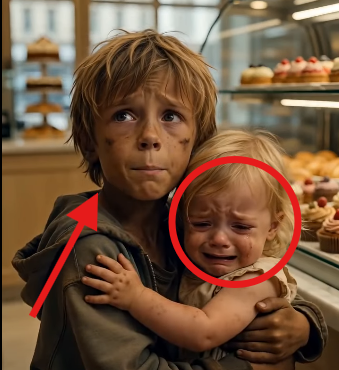
The boy didn’t move.
He just stared at the older man, his eyes full of fear, suspicion, and something even worse—
hope.
That dangerous kind of hope children only get when they have already been disappointed too many times.
The toddler lifted her tear-streaked face and looked at the man too.
The older man noticed the way the boy shielded her with his whole body.
Like a father would.
Or like a child who had no one else.
He lowered his voice.
“You don’t have to be afraid.”
The boy’s jaw tightened.
“That’s what people say before bad things happen.”
The words hit the whole bakery like cold air.
The worker looked down.
A woman by the window covered her mouth.
The older man stood very still for a second, then nodded like he knew the boy had earned the right to say that.
“What’s your name?” he asked gently.
The boy hesitated.
Then answered, barely above a whisper.
“Eli.”
“And hers?”
The boy looked down at the toddler in his arms.
“Mia.”
The man’s face changed when he heard the girl’s name.
Not loudly.
Not theatrically.
Just enough.
Like something old and buried had suddenly been touched.
The boy saw it.
His eyes narrowed.
The older man stepped closer, but carefully this time, so he wouldn’t frighten them.
“I’m not asking you to trust me for free,” he said. “I’m asking you to let me feed her.”
The toddler whimpered again at the word feed and looked back at the bread.
That almost broke the boy.
He looked at the man, then at the counter, then at Mia’s tiny shaking shoulders.
The worker had already started filling large bags with bread, pastries, sandwiches—everything.
The bakery had gone completely quiet except for paper rustling and the little girl’s breathing.
Then the older man looked properly at Mia’s face for the first time.
Really looked.
His eyes locked on a tiny birthmark just below her ear.
And suddenly all the color drained from his face.
His hand lifted halfway toward her—then stopped in midair.
He knew that mark.
The boy took one quick step back.
“What?” he asked.
The older man’s voice almost failed.
“Who is her mother?”
The question made the boy go stiff.
Why that question?
Why now?
He held Mia tighter.
“She died,” he whispered.
The older man closed his eyes for one second like the answer had gone straight through him.
When he opened them again, they were wet.
He looked at the toddler, then at the boy, and his whole voice broke open.
“She had that same mark,” he whispered. “My daughter had that same mark.”
The worker froze.
The customers stared.
The boy’s eyes widened.
The older man took a shaking breath and looked at the little girl like the world had just handed him back a ghost.
Then he looked at Eli.
And asked the question that tore the whole moment open:
“Why didn’t anyone tell me she had children?”