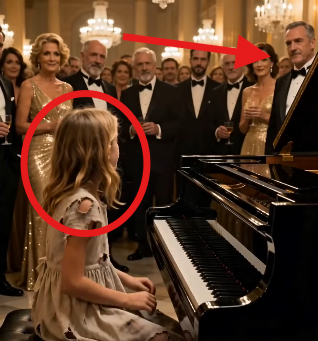
“Clara,” the girl whispered.
The man staggered back like the name had hit him in the chest.
The room fell so silent that even the chandelier seemed too loud.
Years ago, Clara had stood at that same piano in a white dress, laughing softly while he watched her from across the ballroom. She was not rich enough for his family, not polished enough for his world, and when she became pregnant, he let them force her out instead of fighting for her.
Then came the lie.
He was told she had died.
And that the baby had died with her.
But now a barefoot child with Clara’s eyes was sitting at his piano, playing the song he had written for the woman he never stopped loving.
His voice broke.
“Where is your mother?”
The girl’s fingers curled against the edge of the bench.
“She’s outside,” she whispered. “She’s sick.”
The man dropped to his knees beside the piano, not caring that every guest in the room was watching.
The girl flinched at first, but she did not pull away.
“She told me if I played this,” the girl said, “you would know I was yours.”
His face shattered.
Tears filled his eyes as he looked at her properly now—the same chin, the same sadness, the same quiet courage Clara used to wear when she was trying not to cry.
“What’s your name?” he asked.
The girl swallowed hard.
“Lily.”
A broken sound escaped him.
That was the name Clara had chosen years ago, back when they still believed love would be enough.
The wealthy crowd stood frozen in shame around them while the man who had once laughed with them reached for the child with trembling hands.
Then Lily pulled a folded note from her dress and gave it to him.
He opened it and read only one line before his whole body went still.
If she reaches you in time, come quickly.
He looked up at Lily, terrified now.
“She couldn’t walk anymore this morning,” Lily whispered. “But she made me promise to play first.”
And in the middle of the glittering ballroom, the plate of food the child had begged for no longer mattered at all.